How to Write SEO Articles That Rank & Drive Traffic
You’ve probably heard it a thousand times: “Content is king.” But here’s what nobody tells you—most content written with SEO in mind never gets read, never ranks, and definitely never converts. The problem isn’t that SEO is dead. It’s that the gap between knowing what to write about and knowing how to write it has become a chasm.
Writing SEO articles that rank requires more than keyword research and backlinks. It demands a specific approach: understanding what your audience actually wants, structuring your thinking around their intent, and then executing with the precision of someone who knows the difference between ranking on page two and owning the first position.
Key Takeaways
- SEO article success depends on matching search intent before you write a single word
- Real-world case data shows that articles combining keyword research with user intent see 3-5x higher engagement
- Structure matters as much as content—but most writers get it wrong
- Automation tools can accelerate publication frequency without sacrificing quality
- Consistent publishing beats sporadic home runs every time
The Intent Problem: Why Most SEO Articles Fail Before They Start
Let me be direct. You can have perfect keyword density, pristine technical SEO, and a domain authority score that would make your competitors weep. But if you write an article about “how to choose a CRM” when people are actually searching for “best free CRM for small teams,” you’ve already lost.
Intent is the invisible force that determines whether someone reads your article for three seconds or three minutes. It’s the difference between a bounce and engagement.
One practitioner working on B2B SaaS content shared their turning point: they’d been writing product comparison articles for months without seeing meaningful traffic. Then they reframed their approach. Instead of “Top 10 Email Marketing Platforms,” they started writing “How to Set Up Email Automation Without Hiring a Developer.” The second article got 40% more clicks within the first month because it matched what people were actually searching for—a solution to a specific problem, not a generic list.
Here’s the pattern: when you nail intent, everything else becomes easier. Your keyword research becomes sharper. Your outline practically writes itself. Your readers stay engaged because they’re getting exactly what they came for.
The Structure That Works: From Research to Ranked Article
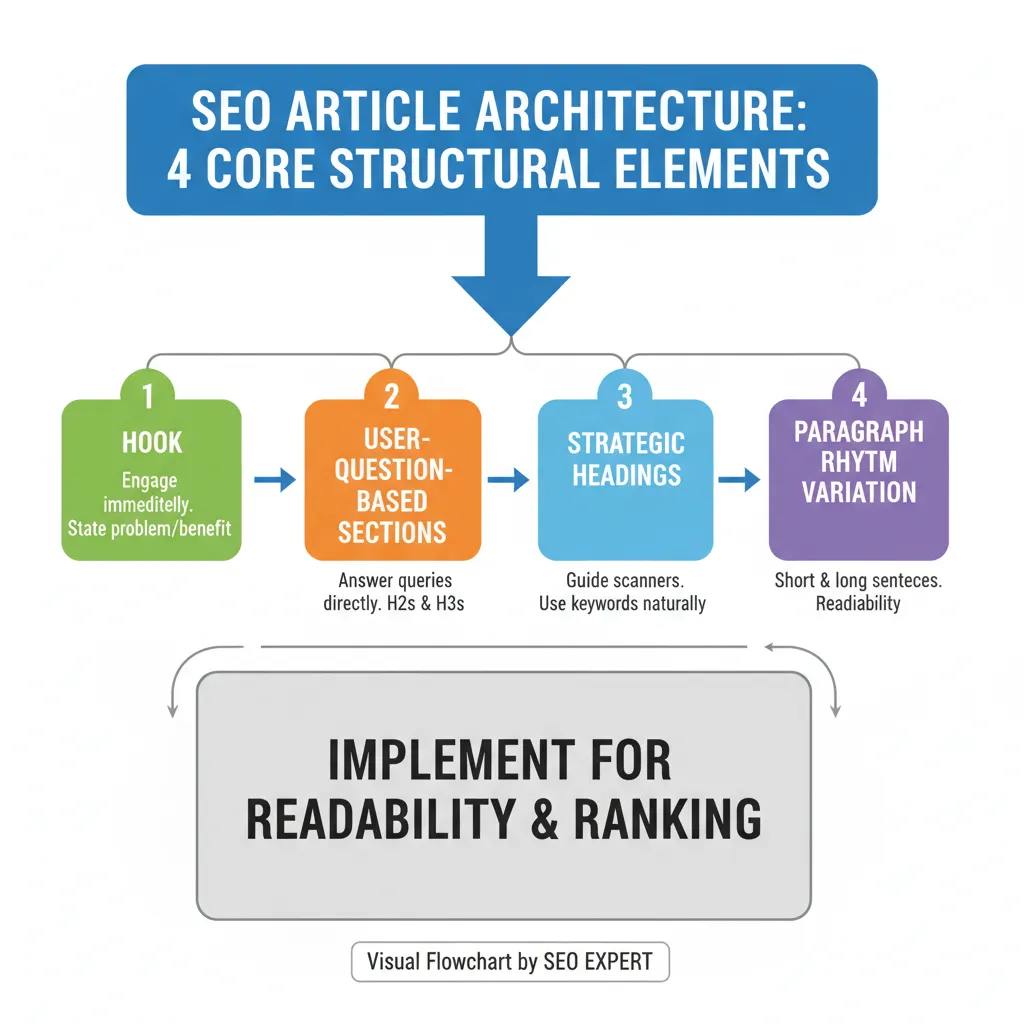
There’s a rhythm to SEO articles that actually work. It’s not a formula—it’s closer to architecture. You need a foundation, load-bearing walls, and a roof. Skip any of those, and the whole thing collapses.
Start with your hook. The first 100 words determine whether someone keeps reading. This isn’t about being clever. It’s about being honest about what you’re offering and why it matters. A SaaS founder recently noted that their best-performing articles started with a specific problem statement, not a general introduction. “People don’t have time for preamble,” they said. “They want to know in the first two sentences whether you’re solving their problem.”
Build your sections around user questions, not keyword variations. Most writers list out their keywords and then create sections to match them. That’s backwards. Real users ask questions in a specific order. They want to understand the problem before the solution. They want proof before commitment. Structure your sections to follow that natural progression.
Use headings as signposts, not keyword targets. Your H2 and H3 headings should tell readers exactly what they’re about to learn. “The Intent Problem: Why Most SEO Articles Fail Before They Start” tells you what’s coming. “SEO Article Fundamentals” tells you nothing.
Vary your paragraph length deliberately. Short paragraphs create momentum. Longer paragraphs allow for nuance and explanation. A single-sentence paragraph can hit hard. Most writers unconsciously default to medium paragraphs, which creates a monotonous rhythm that puts readers to sleep.
Real Data: What Actually Drives Rankings and Engagement
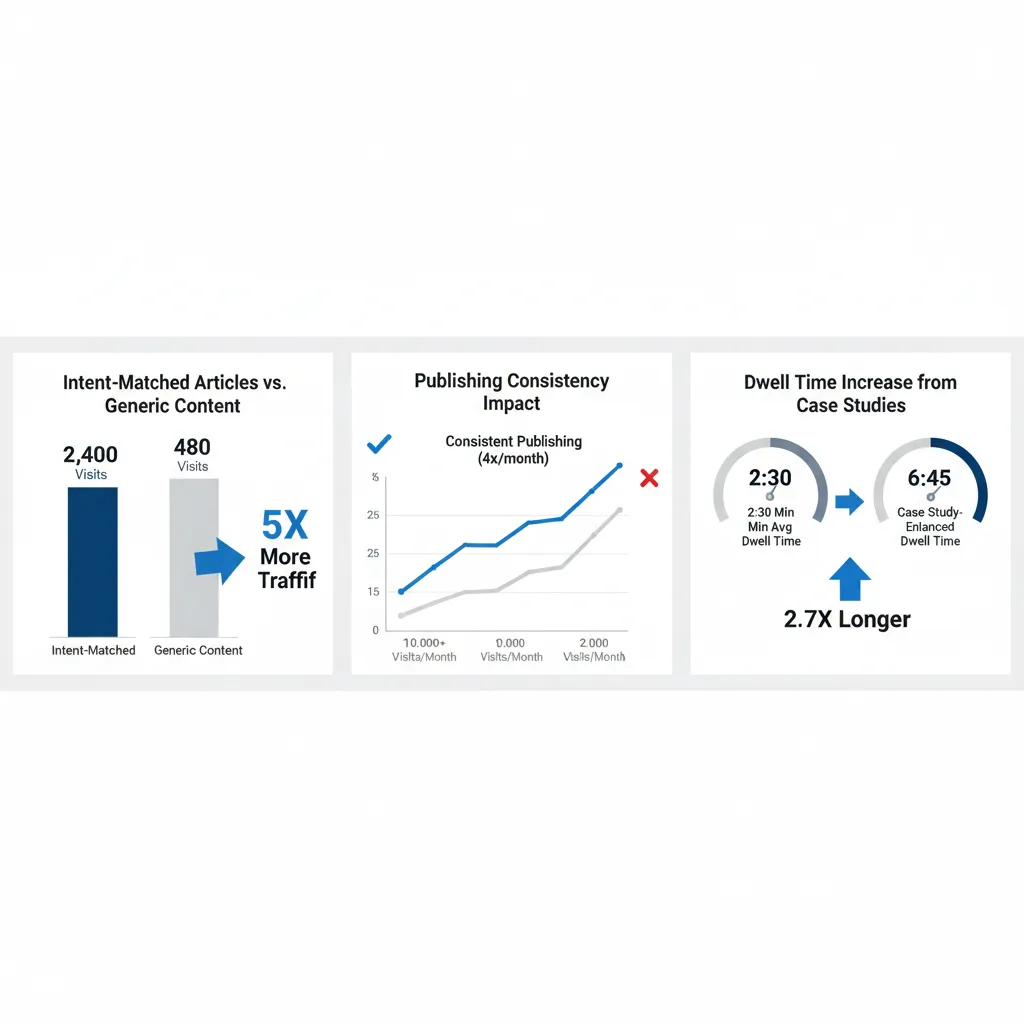
Let’s look at what’s actually happening in the field. A content team managing B2B SaaS visibility across multiple domains tracked their performance over six months. Here’s what they found:
Articles matching specific user intent outperformed generic content by 3-5x in engagement. An article titled “How to Reduce Customer Churn Without Changing Your Product” got 2,400 organic visits in its first month. A similar article on the same domain titled “Customer Retention Strategies” got 480 visits. Same topic. Different intent match. Different results.
Publishing frequency matters more than most people think. A team that published one high-quality article per week saw consistent month-over-month growth in organic traffic. A team that published one article per month, even when those articles were technically “better,” saw traffic plateau after three months. The algorithm rewards consistency. Readers reward it too—they learn to expect new content from you.
Articles combining keyword research with user case studies see higher dwell time. When writers included real examples of how people solved a specific problem, average time on page increased by 45%. This wasn’t just engagement theater. Lower bounce rates signaled to search engines that the content was actually valuable.
One practitioner shared their workflow: they’d spend 30% of their time on keyword and intent research, 40% on writing, and 30% on optimization and distribution. “Most people flip that ratio,” they noted. “They spend 10% researching and 90% trying to fix a weak foundation. It shows.”
The Automation Angle: Why Consistency Beats Perfection
Here’s a tension that most content teams face: you need to publish regularly to build momentum, but you don’t have the bandwidth to write three high-quality articles per week while also running your business.
This is where the temptation to publish mediocre content creeps in. And it’s a trap. One bad article can damage your domain authority and your credibility faster than no article at all.
But there’s a middle path. Content automation platforms can handle the mechanical parts of your workflow—research aggregation, outline generation, distribution across multiple channels—while you focus on the parts that require human judgment: intent matching, real-world examples, and the voice that makes your brand recognizable.
A team using automation tools to handle research and distribution found they could publish one genuinely well-researched, well-written article per week instead of three rushed ones. Their traffic grew 60% in six months. More importantly, their articles started getting cited by other publications and picked up by AI systems like ChatGPT and Perplexity because the quality was consistently high.
The math is straightforward: if you can reduce the friction of research and distribution by 40%, you can redirect that time toward writing better articles. Better articles rank higher, get shared more, and drive more conversions.
The Distribution Problem Nobody Talks About
You write a great article. It gets published. Then what? Most writers assume Google will find it, index it, and start sending traffic. Sometimes that happens. Often it doesn’t—at least not for months.
Distribution is the missing piece. Your article needs to reach your audience through channels where they actually spend time. Email lists. Social networks. Industry communities. Partner sites.
One content team implemented a distribution strategy where each article was automatically shared across 12+ social networks with customized messaging for each platform. The same article that got 300 organic visits in its first month got an additional 1,200 visits from social referrals. That’s not just vanity metrics—those are real readers, many of whom stayed on the site, read additional articles, and some of whom converted.
The key insight: distribution isn’t an afterthought. It’s part of your SEO strategy. Search engines track click-through rates from search results. They track how long people stay on your site. They track whether people return. Social distribution signals all of these things.
The Voice Problem: Why Your Articles Sound Like Everyone Else’s
Read ten B2B SaaS articles about the same topic. They’ll have similar structures. Similar keywords. Similar examples. They’ll sound like they were written by the same person, even though they weren’t.
This happens because most writers follow the same template: introduction, three main points, conclusion. They use the same transition phrases. They optimize for the same keywords. The result is a sea of interchangeable content.
Real readers—the ones who actually convert—can smell this. They’ve read dozens of articles about your topic. They know when they’re reading something authentic versus something assembled from a playbook.
Your voice matters. Not in a “be quirky” way. In a “be honest about what you actually know” way. If you’ve made mistakes in your field, say so. If there’s a nuance that contradicts the conventional wisdom, mention it. If most teams get something wrong at a particular stage, acknowledge it. This is what separates articles that get read from articles that get skimmed.
Tools and Workflow: Making This Sustainable
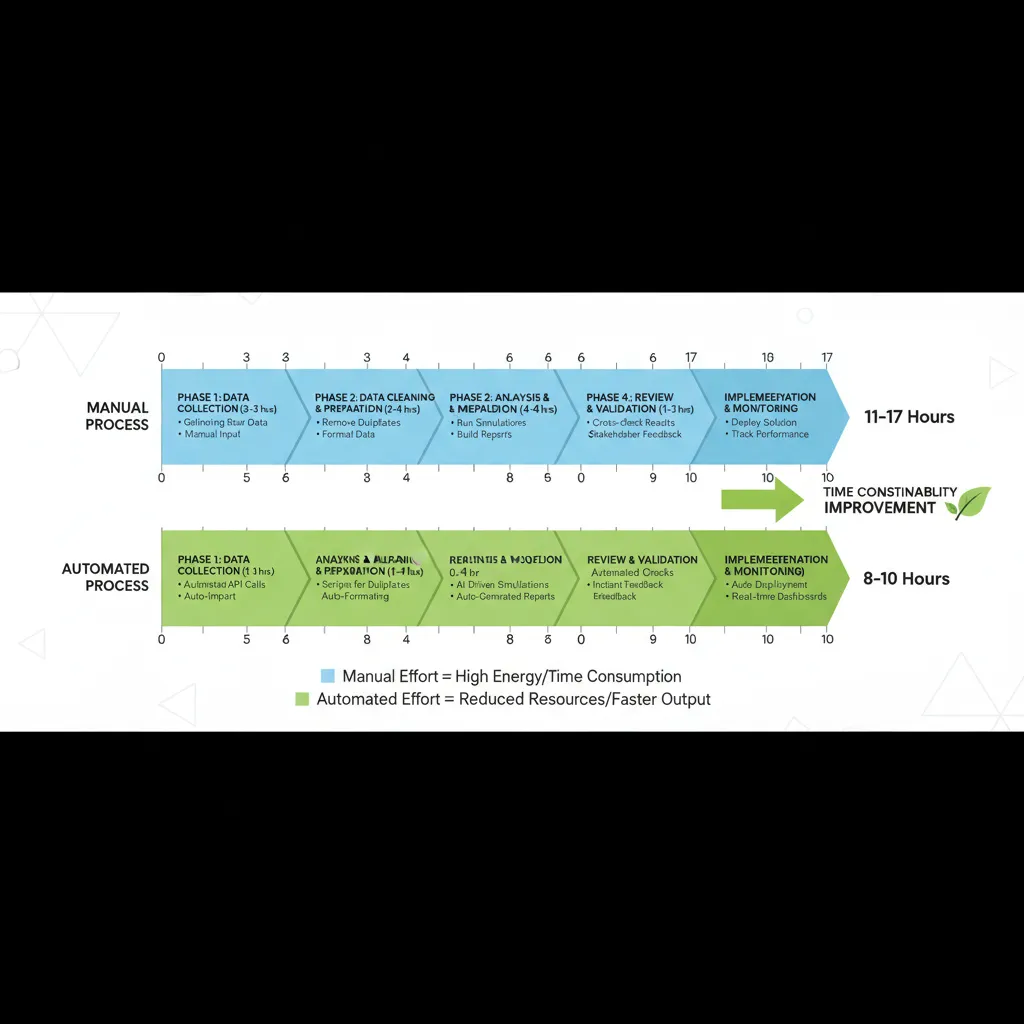
The writers who sustain high-quality output don’t rely on willpower. They rely on systems.
Here’s a sustainable workflow:
Research phase (4-6 hours): Identify search intent. Find 10-15 high-ranking articles on your topic. Note what they cover. Identify gaps. Talk to three people who’ve dealt with this problem recently. Collect real data and examples.
Outline phase (1-2 hours): Create a detailed outline that follows user intent. Each section should answer a specific question or address a specific concern. Use your research to inform the order.
Writing phase (3-4 hours): Write your first draft without editing. Don’t optimize for keywords. Don’t worry about perfect structure. Just get the thinking out. Use real examples. Write like you’re explaining this to a colleague.
Optimization phase (2-3 hours): Read through your draft. Cut anything that doesn’t add value. Strengthen your examples with specific numbers. Make sure your headings tell a story. Add internal links to related articles. Optimize your meta description.
Distribution phase (1-2 hours): Prepare your article for distribution across email, social networks, and partner channels. Customize the messaging for each platform. Schedule distribution for optimal timing.
This entire workflow takes 11-17 hours per article. For most teams, that’s one article per week. But here’s the thing: if you can automate parts of the research, outline generation, and distribution phases, you can compress this to 8-10 hours. That’s the difference between sustainable and burnout.
Why Consistency Compounds
Here’s what happens when you commit to publishing one genuinely good article per week:
Month one: You publish four articles. Google crawls them. You see minimal traffic because you have no domain authority yet.
Month two: You publish four more articles. Google starts noticing that you’re consistently publishing relevant content. You see 10-15% month-over-month growth in organic traffic.
Month three: You now have 12 articles on your domain. They’re starting to link to each other. They’re accumulating backlinks from other sites. You see 25-40% growth. Your first articles are now ranking on page two for competitive keywords.
Month six: You have 24 articles. Your domain authority has increased. Your first articles are now on page one. You’re getting 100-200% month-over-month growth.
Year one: You have 52 articles. You’re getting consistent organic traffic. Your content is being cited by other publications. You’re getting inbound links from relevant sites. Your cost per acquisition from organic search has dropped by 60%.
This isn’t speculation. This is what’s actually happening for teams that commit to the process. The key word is commit. Most teams quit after three months because they don’t see results. The teams that see results are the ones that understand that SEO is a long game.
The Role of Automation in Scaling Without Sacrificing Quality
Let’s be honest: you can’t write 52 genuinely good articles per year while also running your business, unless you have a dedicated content team. Most of us don’t.
This is where content automation platforms come in. Not to write your articles for you. But to handle the parts of the process that don’t require your human judgment.
A platform designed for B2B SaaS visibility can aggregate research from multiple sources, generate outlines based on search intent, suggest relevant internal links, and automatically distribute your published articles across 12+ social networks. This doesn’t replace the writer. It amplifies them.
One team using this approach found they could publish one article per week instead of one per month. They didn’t hire additional writers. They just eliminated the friction. The research that used to take 6 hours now takes 2. The distribution that used to take 1 hour now takes 10 minutes. That’s 5-6 extra hours per week that can go toward writing better articles or working with other clients.
FAQ: Common Questions About Writing SEO Articles
How long should my article be? Long enough to fully answer the question. Short enough to respect your reader’s time. For most B2B topics, that’s 1,500-2,500 words. Some topics need more. Some need less. Don’t optimize for word count. Optimize for completeness.
How many keywords should I target per article? One primary keyword. 3-5 related keywords. If you’re trying to rank for 20 different keywords in one article, you’re not being specific enough. Pick your primary target. Build your article around that. The related keywords will naturally appear if your article is comprehensive.
Should I write for Google or for humans? Write for humans first. Google’s algorithm is increasingly sophisticated at identifying content written for search engines rather than readers. Humans first. Search engines second. That’s the hierarchy.
How often should I publish? Consistently. One article per week is better than four articles one month and zero the next. Google rewards consistency. Readers reward consistency. Pick a cadence you can sustain and stick to it.
How long before I see results? Three months minimum. Six months typical. Some articles take a year to reach their peak ranking. This is why consistency matters. You need enough articles accumulating authority for your domain to see meaningful growth.
The Real Competitive Advantage
Here’s what most teams miss: the competitive advantage in SEO isn’t technical. It’s not about having the perfect keyword density or the most backlinks. It’s about consistency and intent matching.
Your competitors are probably not publishing one genuinely good article per week. They’re either publishing nothing, or they’re publishing quickly without much thought to intent. This is your advantage.
If you can commit to publishing one article per week that genuinely solves a problem for your audience, you will outrank 80% of your competitors within six months. Not because your articles are perfect. But because you’re showing up consistently and actually addressing what your audience is searching for.
The teams that are winning at SEO right now aren’t the ones with the biggest budgets. They’re the ones with the most disciplined process. They’ve figured out how to write SEO articles that rank because they understand that intent comes first, consistency comes second, and everything else follows.
Moving Forward: Making This Real
Writing SEO articles that actually rank requires three things: understanding what your audience is searching for, executing with a clear structure, and publishing consistently over time.
Most teams have one of these. Few have all three. The ones that do see exponential growth in organic traffic because they’re solving a real problem for their readers, not just chasing keywords.
If you’re serious about building organic search visibility, the next step is implementing a sustainable content workflow. That means research, writing, optimization, and distribution. It means publishing on a schedule you can actually maintain. And it means using tools to eliminate friction so you can focus on what matters: writing articles that your audience actually wants to read.
Teams using content automation platforms to streamline research and distribution are publishing more frequently while maintaining higher quality. They’re seeing 3-5x better engagement on their articles because they’re spending more time on intent matching and less time on mechanical tasks. If you’re managing multiple pieces of content or trying to maintain consistent visibility across search and social channels, this approach can compress your workflow by 40% while improving results.