AI for Blog Posts: Generate Organic Traffic Without Hiring Writers
A few months ago, someone on Twitter published a single blog post created entirely by AI. Keyword research, cover image, internal links, screenshots—all of it automated. The result? A 30x increase in Google impressions on a brand-new website.
That’s not a fluke. It’s becoming the new baseline.
The question isn’t whether AI can write blog posts anymore. The question is whether you can afford not to use it.
Key Takeaways
- AI-generated blog posts are ranking on Google and driving measurable organic traffic—teams report 30x increases in impressions and capturing $100K+ in monthly organic traffic value.
- The economics are undeniable: one person is running a business that generates triple the revenue of last year, using AI instead of hiring a full-time team.
- Speed matters more than you think. AI reduces research time from hours to seconds and can generate 200 publication-ready articles in 3 hours.
- The real opportunity isn’t replacement—it’s multiplication. Teams that combine AI with strategic thinking are scaling faster than ever before.
- Consistency and automation are the keys. Publishing 2 posts per day, every day, with AI handling the heavy lifting, creates compounding organic growth.
The Shift: From “Can AI Write?” to “Why Aren’t We Using It?”
There’s a moment that happens in every technology adoption curve. At first, people ask if it works. Then they ask why anyone would use it. Then they panic because everyone else is already using it.
We’re past the first stage with AI for blog posts.
The evidence is everywhere. One content operator built an AI-driven business that now generates $203,871 per month. The system publishes 2 posts per day, automatically, using AI to clone viral formats. Every post is shoppable. It’s running like “Facebook ads in 2009”—that moment when the arbitrage was so obvious that it felt almost unfair.
But here’s what makes this different from hype: these aren’t theoretical numbers. These are real people running real businesses, measuring real results.
A solo founder increased revenue by 25% in three weeks by deploying AI agents to write YouTube scripts and ship product features. He paid $20,000 one time for what would cost $100,000 per year in human employees. The AI never sleeps, never takes a day off, and never makes excuses.
The math is brutal. And it’s working.
What’s Actually Happening: The Three-Layer System

When you strip away the noise, teams that are winning with AI for blog posts are doing three things simultaneously.
Layer 1: Intelligent Input
They’re not just asking AI to write about random topics. They’re feeding it proven niches, high-intent keywords, and viral formats that already work. One operator extracts keyword goldmines from Google Trends automatically, then scrapes competitor content with 99.5% success to understand what’s already ranking. The AI doesn’t start from zero—it starts from data.
This is the difference between “write me a blog post” and “write me a blog post that ranks.” One takes luck. The other takes strategy.
Layer 2: Automation at Scale
The second layer is about volume and consistency. Publishing 2 posts per day, every single day, is impossible with a human writer. It’s also not necessary with AI. One team generates 200 publication-ready articles in 3 hours. Another built an n8n automation that converts 100+ existing blog posts into YouTube videos reaching 200,000+ viewers.
The magic isn’t in each individual piece. It’s in the compounding effect of consistent, regular publishing. Google rewards freshness and authority. AI makes freshness affordable.
Layer 3: Human Judgment
Here’s the part that most AI hype misses: the best systems still have humans in the loop. One team uses “tight prompting with human-in-the-loop systems” to refine AI-generated video scripts before publishing. They’re not replacing human judgment. They’re multiplying it.
The human decides the strategy. The human picks the niches. The human reviews the top 20% of outputs. The AI handles everything else.
The Real Numbers: What’s Actually Working
Let’s talk specifics, because vague claims about “scaling content” don’t mean much.
Organic Traffic Value
One operator reports capturing $100K+ in organic traffic value per month using AI-generated content. This isn’t vanity metrics—it’s the estimated value of organic traffic if they were buying it through paid channels. For a new website, a 30x increase in Google impressions is the early signal that this approach works.
These aren’t miracle numbers. They’re the result of consistent publishing, proper keyword research, and letting the system run long enough to compound.
Revenue Impact
The $203,871/month business is built on a specific model: proven niches, 2 posts per day, shoppable content. That’s not 200 blog posts generating revenue directly. That’s a system where every piece of content is designed to drive a transaction.
A solo founder running an AI-augmented business saw revenue increase 25% in three weeks. His total revenue projection for the year is triple what it was last year. He’s one person. The only difference is that he now has “AI employees” running 24/7.
Time Compression
This might be the most underrated metric. Research time compressed from hours to seconds. 200 articles in 3 hours instead of 200 articles over 10 weeks. One person doing the work of 5.
Time is the real constraint for most businesses. You can hire writers, but you can’t hire more time. AI removes that bottleneck.
The Workflow: How Teams Are Actually Doing This
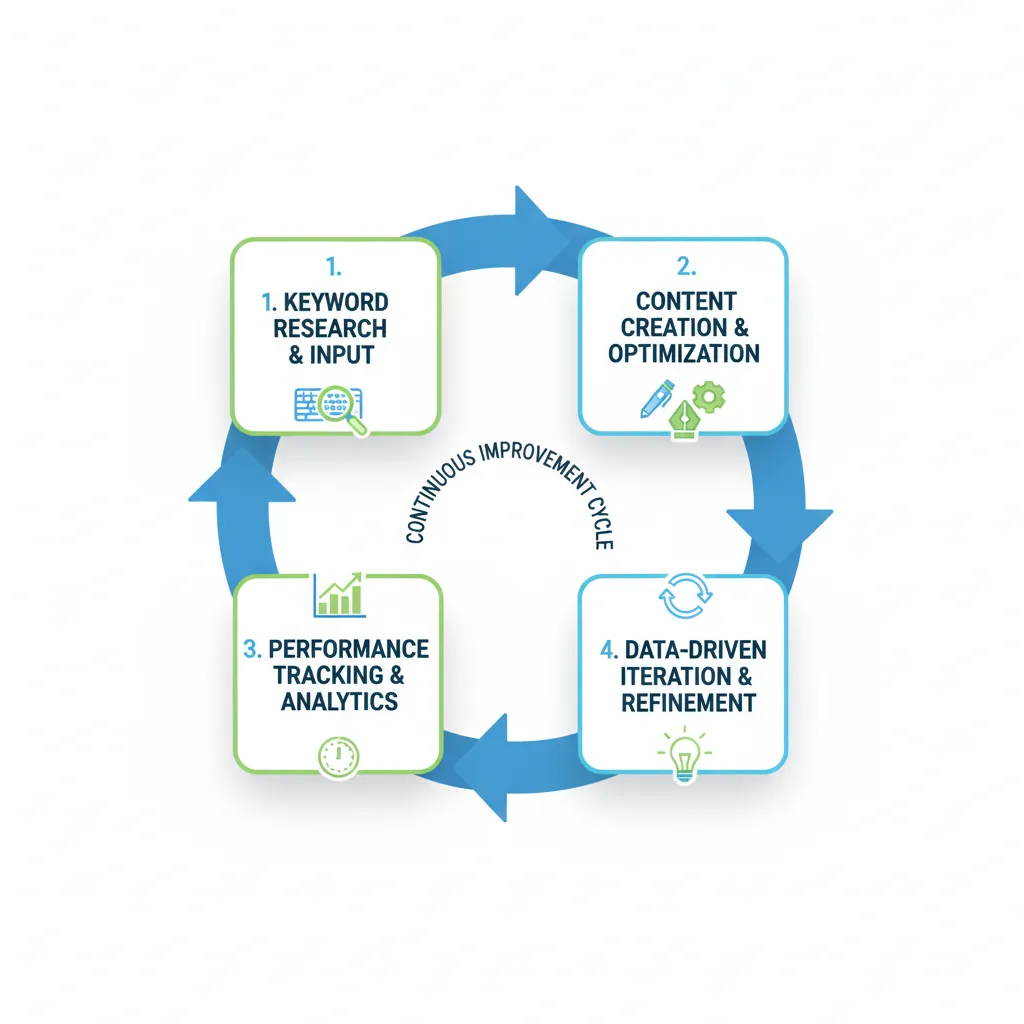
So what does this actually look like in practice?
Step 1: Feed the System
Start with keyword research. Use AI to extract keywords from Google Trends. Identify proven niches where demand is high and competition is manageable. Look at what your competitors are publishing and what’s already ranking. This isn’t guesswork—it’s data-driven input.
Step 2: Generate at Scale
Create a system that can generate multiple pieces of content without manual intervention each time. This might be an AI writing tool, a custom automation using n8n or similar platforms, or a combination of both. The goal is to go from “write one blog post” to “generate 50 blog posts.”
One team does this by cloning viral formats with AI. Another by converting existing blog content into multiple formats (blog posts, YouTube videos, social clips). The method varies, but the principle is the same: one input, many outputs.
Step 3: Publish Consistently
This is where most people fail. They generate content and then publish sporadically. The winning teams publish on a schedule: 2 posts per day, every day. Or they batch-publish on a fixed cadence. The consistency matters more than the frequency.
Step 4: Measure and Refine
Track what works. Which topics get clicks? Which formats drive conversions? Which keywords bring qualified traffic? Use this data to feed back into Step 1. The system gets better over time, not worse.
The Objections (and Why They’re Mostly Wrong)
There’s always resistance to new approaches. Let’s address the real ones.
“AI content isn’t good enough to rank”
The evidence contradicts this. A 30x increase in impressions on a new website. $100K+ in monthly organic traffic value. Multiple people reporting consistent ranking results. AI-generated content is ranking. The question is whether it’s strategically placed and properly optimized, not whether Google can tell it’s AI.
“This won’t work long-term”
Maybe. But “long-term” is a moving target. One operator acknowledged this: “Still too early to say if this works long term.” Fair point. But short-term results are real, and they’re compounding. Even if this approach only works for 12 months before Google changes the game, that’s 12 months of competitive advantage.
“It’s just luck”
One tweet explicitly pushes back on this: “This isn’t luck—it’s a repeatable system.” And the evidence supports it. Multiple people using similar approaches (proven niches, consistent publishing, AI generation) are all seeing similar results. That’s not luck. That’s a pattern.
“You’re just replacing writers”
Wrong framing. You’re not replacing writers. You’re replacing the constraint. A human writer can produce maybe 4-5 good blog posts per week. AI can produce 200 in 3 hours. That’s not replacement—that’s multiplication. The human can now focus on strategy, on picking which niches to enter, on refining the top 20% of outputs. The AI handles the grunt work.
The Economics Are Changing
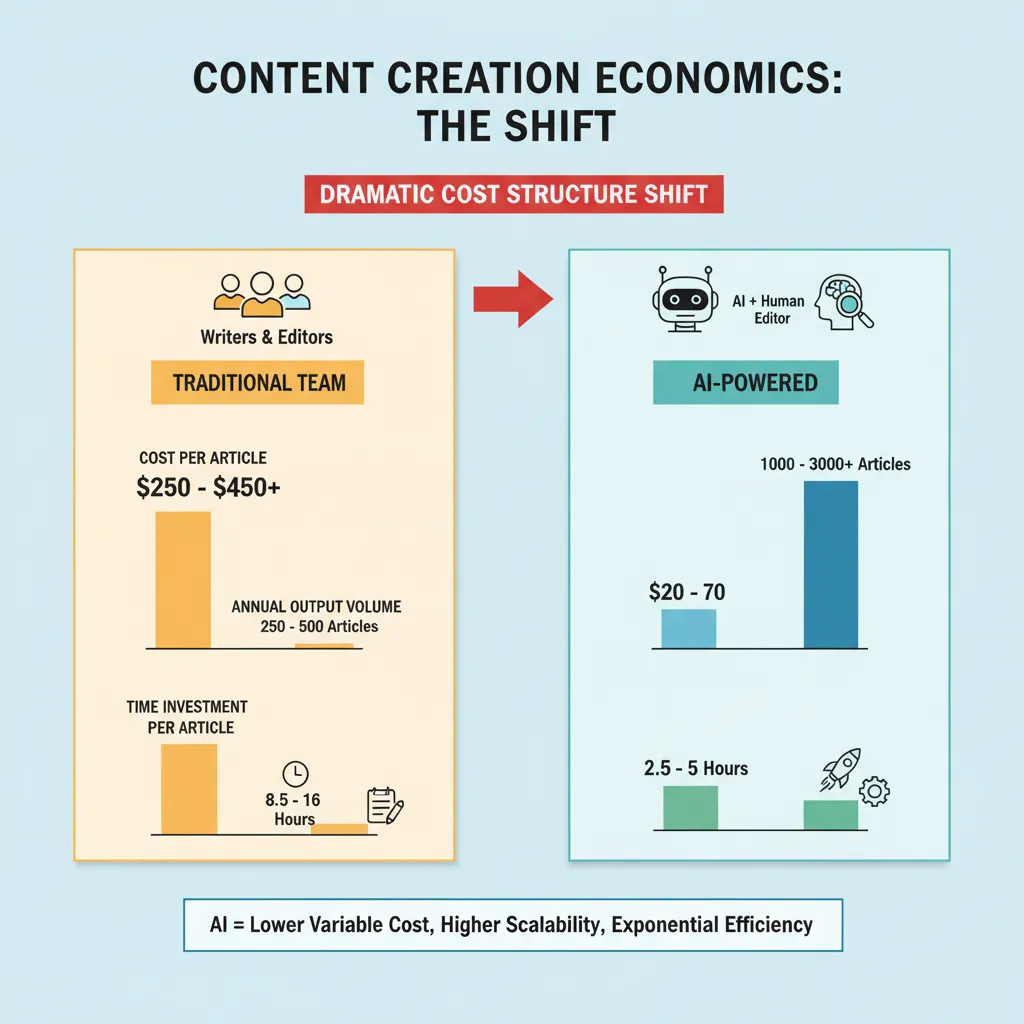
Here’s the uncomfortable truth: the cost structure of content marketing is being inverted.
Traditionally, you hire a content team. That team costs $50K-$200K per year depending on size and quality. They produce maybe 50-100 blog posts per year. That’s $500-$4,000 per article.
With AI, one person can generate 200 articles per month. The cost per article drops to near zero after the initial setup. The time constraint is gone. The only remaining question is: what do you do with all that capacity?
One operator paid $20,000 one time for AI agents that replace $100,000/year in human employees. That’s not a small difference. That’s a 5x cost reduction on the same work output.
The teams that understand this shift first will dominate. The teams that don’t will eventually be forced to adapt or lose.
What Actually Matters Now
If AI can generate blog posts, then the competitive advantage isn’t in generation anymore. It’s in three things:
1. Strategic Thinking
Which niches to enter? Which keywords to target? Which formats work best for your audience? This is still human work. AI can help, but the strategy has to come from someone who understands the business.
2. Consistency
Publishing 2 posts per day, every single day, for 12 months. That’s 730 posts. Most teams can’t maintain that discipline. The ones that do win. AI makes it possible. Discipline makes it happen.
3. Integration
AI-generated blog posts that don’t connect to anything are just noise. The winning systems make every post shoppable, or convert posts into videos, or repurpose them across 12+ platforms. The content ecosystem matters more than the individual piece.
The Repurposing Multiplier
One creator built an automation that turned 100+ existing blog posts into YouTube videos reaching 200,000+ viewers. The blog posts were already written. The AI just converted them.
This is the hidden multiplier that most people miss. You don’t need to generate new content for every channel. You need to repurpose existing content smartly.
A blog post becomes a YouTube script. The script becomes a YouTube Shorts clip. The clip becomes a LinkedIn post. The LinkedIn post becomes a Twitter thread. One piece of content, five distribution channels, five audiences.
AI makes this possible at scale. Manual repurposing would take hours per piece. Automated repurposing takes minutes.
The Setup: What You Actually Need
You don’t need a complex tech stack. One operator did this with 30 minutes of setup using native nodes. Another used n8n automation. A third used a combination of AI writing tools and manual publishing.
The pattern is simpler than it looks:
1. Pick your tool (AI writing platform, automation service, or custom setup)
2. Feed it your strategy (keywords, niches, formats)
3. Set it to generate consistently
4. Publish on a schedule
5. Measure and iterate
That’s it. No PhD required. No complex infrastructure. Just strategic thinking and consistent execution.
The Missing Piece: Distribution and Visibility
Here’s where most AI content projects fail: they generate content in a vacuum.
You can generate 200 blog posts, but if nobody sees them, they don’t matter. You can publish 2 posts per day, but if they’re not reaching your audience, the traffic won’t come.
The winning teams solve this in two ways. First, they optimize for search intent from the beginning. They’re not generating random content—they’re generating content for keywords that people are actually searching for. Second, they distribute across multiple channels automatically.
This is where platforms that handle both content generation and distribution become valuable. You want your AI-generated blog posts to automatically land on your website, your social channels, and your email list. You want them indexed by search engines and surfaced in AI-powered answers. You want maximum visibility with minimum manual effort.
That’s the real multiplier: not just generating content, but ensuring it reaches the right people at the right time, consistently, without you having to manually publish each piece.
Real Talk: The Limitations
None of this is magic. There are real constraints.
First, AI-generated content can be generic. It needs strategy and refinement. One team uses “human-in-the-loop” systems to filter and improve outputs. The best results come from AI doing 80% of the work and humans doing the final 20%.
Second, Google’s algorithms change. What works today might not work in 12 months. One operator acknowledged this: “Still too early to say if this works long term.” Fair. But even if the advantage is temporary, it’s still an advantage.
Third, quality matters. You can’t just publish garbage at scale and expect results. The AI needs good input, good prompting, and good oversight. Garbage in, garbage out is still true.
Fourth, your audience can tell when content is phoned in. AI-generated content that feels hollow won’t convert, no matter how much traffic it brings. The best results come from AI handling the heavy lifting while humans ensure the strategic intent and voice come through.
FAQ: What People Actually Want to Know
Q: Will Google penalize AI-generated content?
A: Google has said it cares about quality, not origin. AI-generated content that ranks well and satisfies search intent is treated the same as human-written content. The content itself is what matters, not who (or what) created it.
Q: How much does this cost to set up?
A: One operator spent 30 minutes and zero dollars. Another paid $20,000 for AI agents. Most setups fall somewhere in between. The cost depends on the complexity you want and the tools you choose. Start simple, then scale.
Q: Can one person really run this?
A: Yes. One person is currently running a business that generates triple the revenue of last year, using AI to handle content, product features, and customer interactions. The constraint is no longer human capacity—it’s strategic thinking.
Q: How long until results show up?
A: A new website saw a 30x increase in impressions fairly quickly. But “fairly quickly” is relative. Most SEO takes 3-6 months to show real traction. Consistency matters more than speed.
Q: Is this sustainable?
A: Unknown. Google might change the game. But even if this particular approach only works for 12 months, that’s 12 months of competitive advantage. The teams that move first will build a lead that’s hard to catch.
The Real Opportunity: Consistency at Scale
The biggest advantage of AI for blog posts isn’t that it’s better than human writers. It’s that it’s consistent and scalable in ways humans can’t be.
A human writer has a bad day. They get sick. They take vacation. They have competing priorities. AI doesn’t. AI publishes 2 posts per day, every single day, for as long as you let it run.
Consistency compounds. One post per week is 52 posts per year. Two posts per day is 730 posts per year. That’s a 14x difference in content volume. Even if each individual post is slightly lower quality, the volume advantage is so large that it doesn’t matter.
This is what “compounding” actually means in content marketing. It’s not about one viral post. It’s about showing up reliably, repeatedly, with relevant content, until Google and your audience notice.
The Next Step: Making This Work for Your Business
If you’re reading this and thinking “okay, but how do I actually implement this?” here’s the honest answer: it depends on your situation.
If you have a new website with no traffic, start with keyword research and consistent publishing. Pick a niche, generate 50 blog posts using AI, and publish 2 per day for a month. Measure the results.
If you have existing blog posts, repurpose them. Convert them into videos, social clips, email sequences. One piece of content, multiple formats, multiple audiences.
If you’re a solo founder, this is your competitive advantage. You can do the work of a 5-person team using AI. Use that advantage to build faster than anyone else.
If you’re a larger team, the advantage is different. You can scale content production without scaling headcount. You can test more niches, more formats, more strategies. You can move faster than competitors who are still hiring writers.
The common thread: start with strategy, use AI to execute at scale, measure results, and iterate. Consistency beats perfection. Volume beats polish. Speed beats caution.
And if you’re serious about making this work—if you want to generate blog posts consistently, ensure they rank for the right keywords, and reach your audience automatically across search and social—then you need a system that handles both generation and distribution. A platform that can take your content strategy, generate high-quality blog posts, optimize them for search intent, and publish them across 12+ channels automatically, without you having to manually manage each piece.
That’s what platforms like TeamGrain do. They’re built for exactly this use case: teams that want to generate organic traffic consistently without hiring a full content team or spending hours on manual publishing.
Conclusion: The Window Is Now
The teams that figure out AI for blog posts now will have a 12-month head start on everyone else. That’s not forever, but it’s significant.
In 12 months, everyone will be using AI to generate content. It won’t be a competitive advantage anymore—it’ll be table stakes. The teams that move now will have already built authority, traffic, and revenue. The teams that wait will be playing catch-up.
The question isn’t whether AI for blog posts works. The evidence is clear: it does. The question is whether you’re going to be the team that figures out how to use it first, or the team that figures it out after your competitors already have.
The window is open. It won’t stay open forever.