AI Content Strategy: Volume to Visibility
Most teams are doing it wrong. They pile on the volume, publish more articles, post more frequently, and wonder why their pipeline doesn’t move. An early-stage brand hit 5 million Instagram views in 10 weeks with just two freelancers and AI. A B2B SaaS company went from consistent but useless traffic to an 825% increase in three months by doing the opposite of what everyone recommends. The pattern is clear: AI content strategy isn’t about scaling output. It’s about scaling clarity.
Key Takeaways
- Volume without strategy kills ROI. The brands winning today focus on audience understanding first, then use AI to execute faster.
- Topical authority works when you combine AI drafting (3x faster) with human expertise and strong internal linking—not when you rely on AI alone.
- AI visibility matters now. Buyers ask ChatGPT and Claude for recommendations before they search. Your pages need to answer what AI systems surface.
- The real moat is taste—the human ability to know what not to create. AI handles execution. Humans guide strategy.
- Structure before automation. Pillar content, keyword clusters, and clear ICP come first. AI fills in the gaps.
The Volume Trap and Why It’s Costing You Money
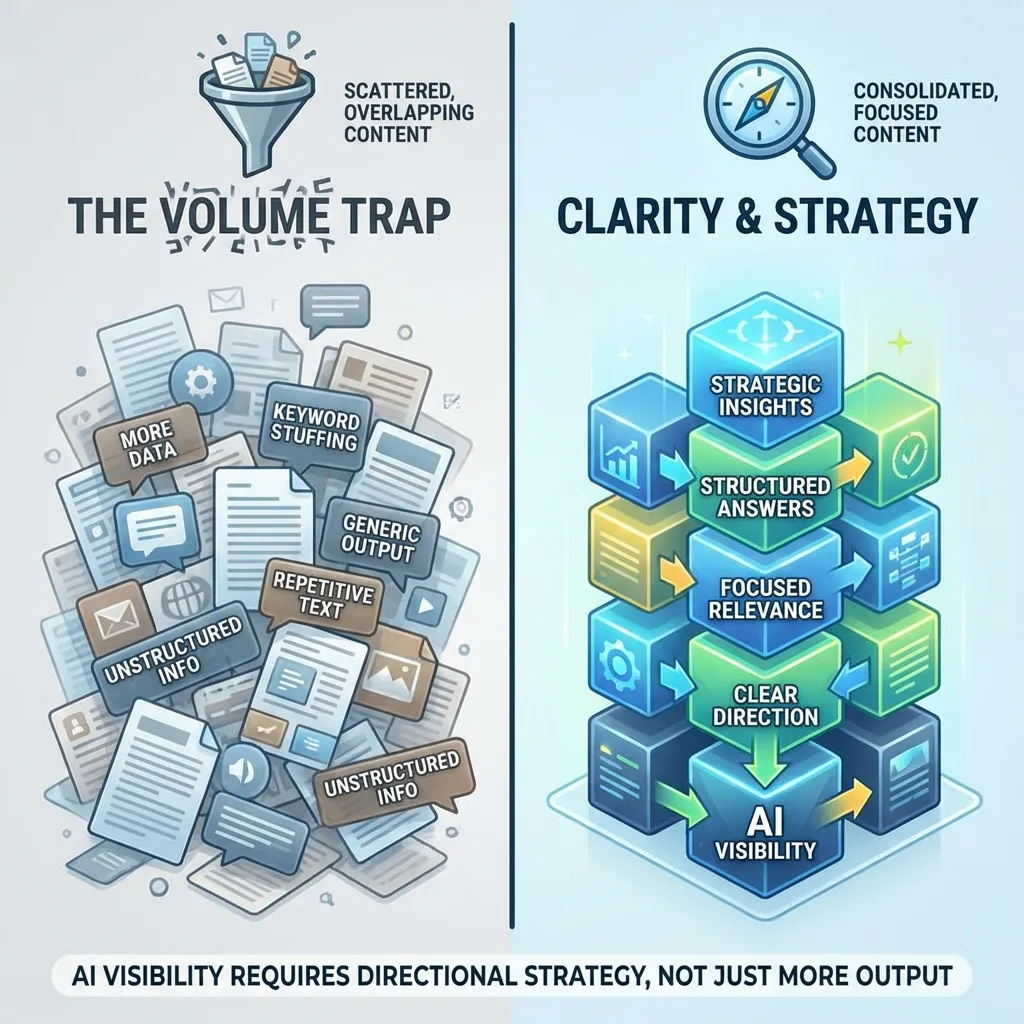
Here’s what happened to a B2B SaaS company that came to one consultant with a “solid SEO foundation.” They had consistent organic traffic. Their content covered multiple stages of the buyer journey. On paper, it looked good.
But their pipeline was broken.
Competitors were stealing tens of thousands of dollars from them every month. Why? Because when buyers asked ChatGPT or Claude which tool to use in their category, they were never mentioned. The traffic existed. The conversions didn’t. The company had fallen into the volume trap—more articles, more keywords, more noise.
So instead of scaling output, they did a 180. They consolidated overlapping pages that competed with each other. They narrowed their site around one core problem buyers actually struggled with. They rebuilt key pages to answer the exact objections buyers ask AI before purchasing.
The results: $37,300 in monthly organic traffic value. An 825% increase in organic traffic in three months. SEO became their primary acquisition channel.
The lesson isn’t subtle. Most teams still think SEO is a volume game. But buyers aren’t browsing anymore. They’re asking for recommendations. And clarity beats volume when the decision is made upstream.
Understanding Your Audience First, Then Using AI to Execute
A consultant working with an early-stage brand wanted to grow its social media presence. In 10 weeks, the brand hit 5 million views on Instagram. No in-house team. No influencers. Just two freelancers who knew their craft and two user insights that told them what to create.
They used AI to reduce the cost of creation and experiment faster. But—and this is the critical part—AI was never the strategy. It was the tool.
The real work was understanding the audience. Knowing what would resonate. Understanding nuance and subtext. This is what one observer called “taste”—the human ability to curate, to select the outlier, to understand what not to create. In a world where everyone has access to the same AI tools, taste is the only defensible moat.
Blitzkrieging your way through content by using AI tools is not a strategy. Volume means nothing. It’s what you choose to do and how you decide to do it. The brands that win are the ones that start with user understanding, then let AI handle the heavy lifting of drafting and formatting.
Topical Authority: How AI and Humans Work Together
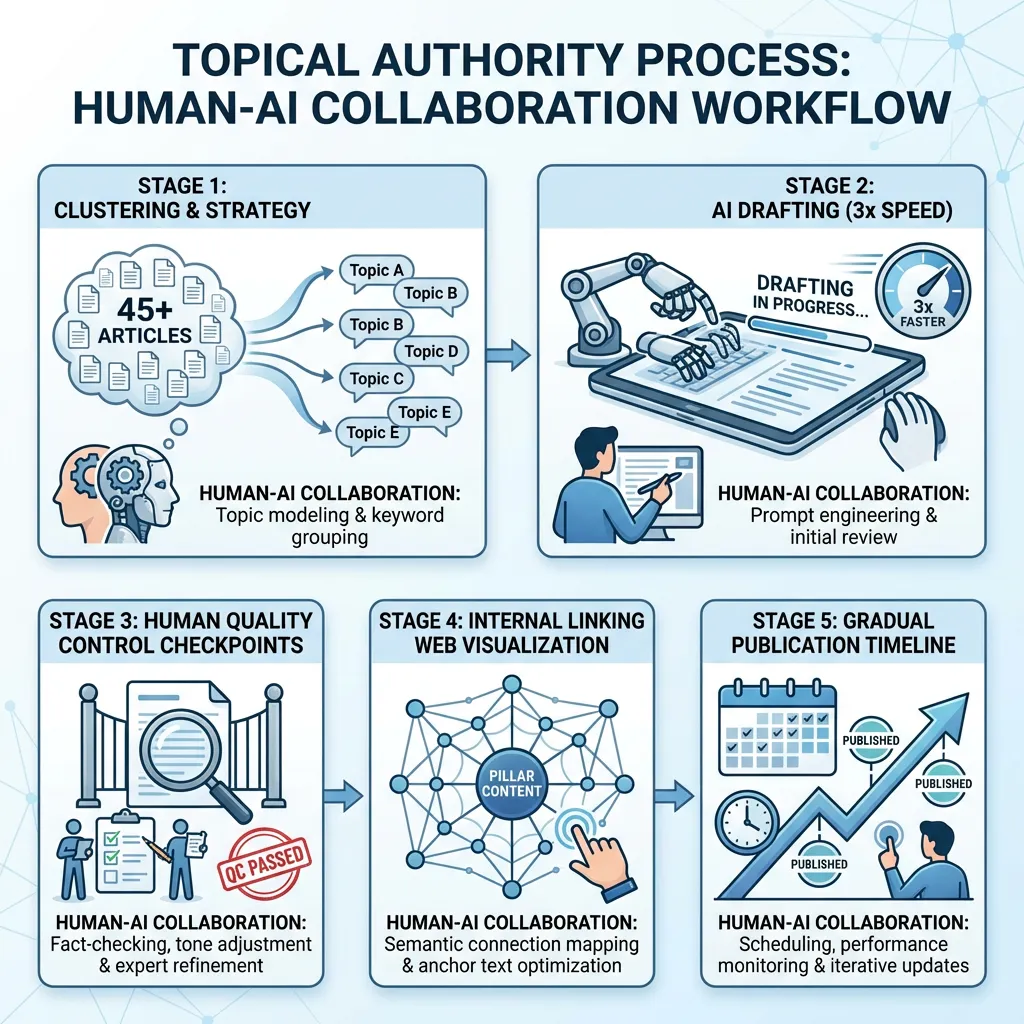
Building topical authority with AI works when you follow a specific pattern. One SEO practitioner tested this and ranked 2,847 keywords in six months, generating 28,900 monthly sessions.
Here’s how they did it:
Step 1: Create a comprehensive cluster. They built 45+ articles covering all angles of their topic. This wasn’t random content. It was structured around related keywords and different buyer journey stages.
Step 2: Let AI handle the drafting. AI was 3x faster than manual writing. This meant they could produce more without hiring more people. But—and this matters—they didn’t publish what AI generated.
Step 3: Human editing is mandatory. Every piece went through quality control. Expertise was verified. Claims were checked. The human layer ensured the content was actually authoritative, not just plausible.
Step 4: Build strong internal linking. Over 400 connections wove the articles together, creating a web of topical authority that search engines recognize.
Step 5: Publish gradually. They rolled out the content over eight weeks instead of dumping it all at once. This allowed them to monitor performance and adjust as needed.
The investment was modest: 92 hours of human time plus $240 in AI tools. The return was 2,847 keywords ranked and nearly 29,000 monthly sessions. This is what happens when you use AI to scale production but keep humans in charge of quality.
AI Visibility: The New Ranking Factor Nobody Talks About
Here’s a shift that most content teams haven’t caught up with yet. Buyers aren’t just searching Google anymore. They’re asking ChatGPT and Claude for recommendations. And if your content doesn’t show up in those answers, you don’t exist to them.
One agency noticed this and changed their entire approach. Instead of optimizing for traditional search rankings, they rebuilt key pages to answer the exact objections buyers ask AI before purchasing. They consolidated overlapping content that was cannibalizing itself. They narrowed focus to one core problem their audience actually struggled with.
The result was an 825% increase in organic traffic in three months. But more importantly, they became visible in AI answers. When buyers asked Claude or ChatGPT for a solution, the company was mentioned.
This is the new game. Your content needs to answer the questions that AI systems surface. It needs to be clear enough that when an LLM summarizes your page, the key points are obvious. It needs to address objections directly, not bury them in prose.
Structuring Content Before You Automate It
One indie builder hit 300+ daily clicks in three months with AI-generated content. No ads. No influencers. Just smart structure.
The pattern was: pillars + related keywords + low-competition targets, then AI fills in the gaps.
This is different from just dumping AI-generated content into the world. It’s different from hoping volume will work. The structure comes first. You decide what topics matter. You map the keyword landscape. You identify where you can win. Then AI handles the drafting and formatting.
This approach works because structure gives AI direction. Without it, AI generates plausible but undirected content. With it, AI becomes a force multiplier for a strategy that already makes sense.
Real Numbers: What Actually Works
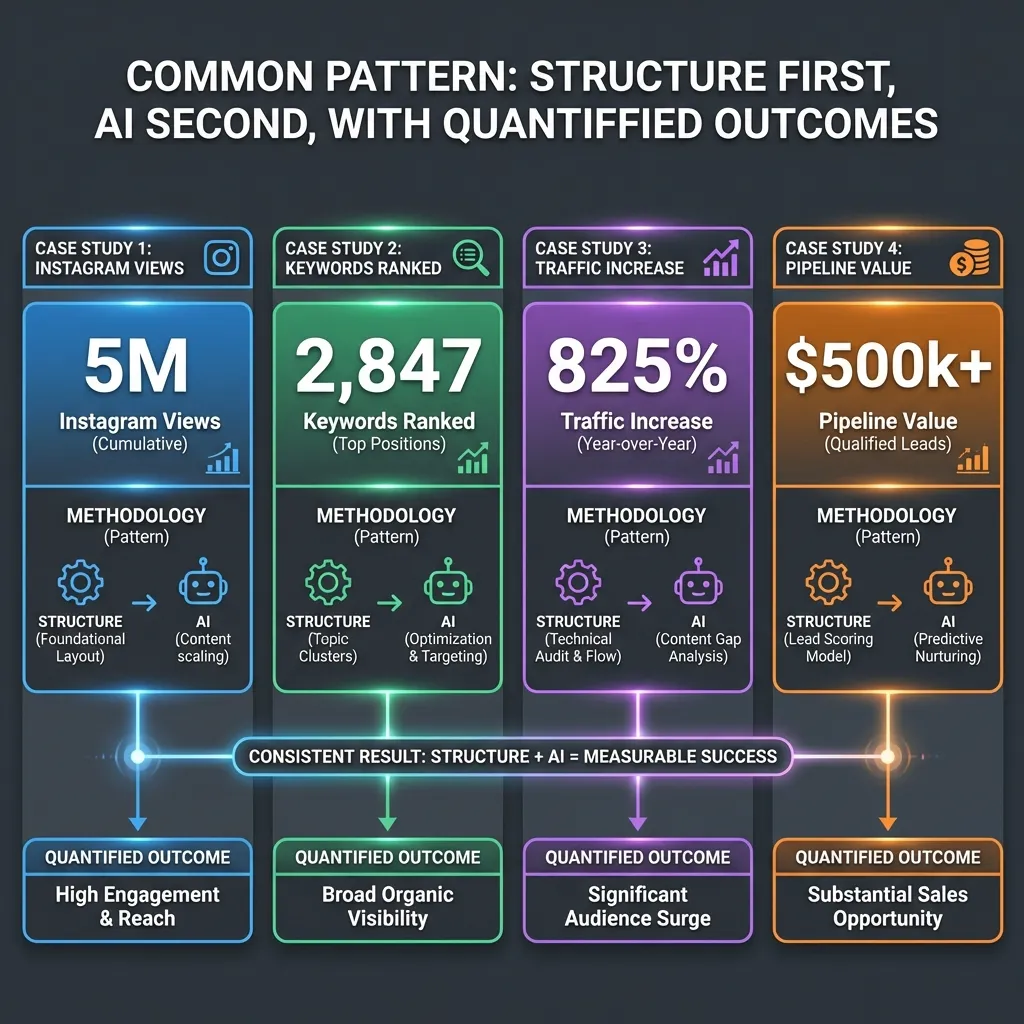
Let’s look at what practitioners have actually achieved with thoughtful AI content strategy:
Case 1: Instagram Growth Through Audience Understanding
A brand with no in-house team hit 5 million Instagram views in 10 weeks. They used AI for creation efficiency but started with user insights. The strategy was clear before the tools were deployed.
Case 2: Topical Authority at Scale
45+ articles, 92 hours of human work, $240 in AI tools. Result: 2,847 keywords ranked, 28,900 monthly sessions in six months. This is what happens when you combine AI drafting with human expertise and strong structure.
Case 3: AI Visibility and Pipeline Impact
A B2B SaaS company consolidated overlapping pages and rebuilt them to answer AI-queried objections. In three months: 825% increase in organic traffic, $37,300 monthly organic traffic value, and SEO as the primary acquisition channel.
Case 4: Content Engine for Lead Generation
An agency posted 7x per week on LLM SEO topics for their niche (SaaS companies with underperforming content). In 90 days: 145 calls booked, multiple $5k-$10k per month deals closed, $500k+ pipeline generated. The content engine drove 60% of inbound calls.
The common thread: structure first, AI second. Audience understanding before volume. Quality control after automation. These aren’t optional steps. They’re what separates the winners from the noise.
The Role of Human Taste in an AI-Powered World
One observer nailed it: “If you use AI to guide your strategy, you are opting for mediocrity at scale.”
Taste—the human ability to curate, to select the outlier, to understand nuance and subtext—is becoming the only defensible moat. Everyone has access to the same AI models. Everyone can generate content fast. The difference is in what you choose to create and how you decide to do it.
This means your job isn’t to replace human judgment with AI. It’s to use AI to handle the execution while humans focus on strategy. Let AI draft. Let humans edit, refine, and decide what actually goes live. Let AI format and optimize. Let humans ensure it’s authoritative.
The brands winning right now aren’t the ones with the biggest AI budgets. They’re the ones with the clearest understanding of their audience and the discipline to say no to mediocre content, no matter how fast AI can generate it.
Building Your AI Content Strategy: Practical Steps
1. Start with audience research, not keywords. Understand what your buyers actually care about. What keeps them up at night? What objections do they raise? What questions do they ask AI systems? This comes before you write a single word.
2. Map your content structure. Decide on pillar topics. Identify related keywords and low-competition opportunities. Plan internal linking before you write. This gives AI direction when you deploy it.
3. Build a content cluster, not random articles. Aim for 45+ articles covering all angles of your core topic. This creates topical authority that search engines and AI systems recognize.
4. Use AI for drafting, not strategy. Let AI handle the heavy lifting of writing and formatting. But every piece goes through human review. Expertise is verified. Claims are checked. Quality control is mandatory.
5. Optimize for AI visibility. Your pages need to answer the questions that ChatGPT, Claude, and other LLMs surface. Be direct. Answer objections clearly. Make the key points obvious.
6. Publish gradually and monitor. Don’t dump all your content at once. Roll it out over weeks. Watch what works. Adjust as needed. This approach gives you data to refine your strategy.
7. Focus on clarity, not volume. A small number of exceptional, well-linked pages beats a large number of mediocre ones. Consolidate overlapping content. Narrow your focus. Make every page count.
Where Most Teams Go Wrong
The biggest mistake is thinking AI content strategy means more output. It doesn’t. It means smarter output.
Teams often skip the audience research phase. They jump straight to AI generation. The result is plausible but directionless content that doesn’t move the needle.
They also treat AI as a replacement for human judgment, not a tool to augment it. This leads to mediocrity at scale—exactly what you’re trying to avoid.
Another common trap: publishing without structure. Random articles on random topics don’t build topical authority. They just add noise. Your content needs to be part of a coherent whole.
And many teams ignore AI visibility. They optimize for traditional search and miss the fact that buyers are now asking AI systems for recommendations. Your content needs to show up in those answers.
Tools and Next Steps
The specific tools matter less than the approach. You need:
- An AI writing tool for drafting (many options available)
- A content management system for structure and internal linking
- An SEO tool to identify keywords and monitor rankings
- A process for human review and editing
But here’s the thing: tools don’t execute strategy. People do. The real work is in the thinking, the planning, and the discipline to maintain quality.
If you’re publishing regularly and want your content to drive both search visibility and AI answers, you need a system that combines AI efficiency with human oversight. This is where most teams struggle—they have the tools, but not the process.
This is also where platforms designed for content automation with human control become valuable. A system that lets you generate content at scale while maintaining editorial control, distributing across multiple channels, and monitoring performance can save months of manual work. TeamGrain, for example, is built for exactly this: AI-powered content generation with human editing, automatic distribution across 12+ social networks, and built-in SEO optimization. It turns your content engine into something that actually scales without losing quality.
FAQ
Q: Is AI-generated content bad for SEO?
A: Not if you pair it with human expertise and structure. AI drafting is 3x faster than manual writing. But every piece needs human review. The combination of AI speed and human judgment outperforms both alone.
Q: How much content do I need for topical authority?
A: The practitioners who succeeded aimed for 45+ articles covering all angles of their core topic. This creates a web of topical authority that search engines recognize. But quality matters more than quantity.
Q: Does volume still matter?
A: Not the way it used to. A small number of exceptional, well-linked pages beats a large number of mediocre ones. The brands winning today focus on clarity over volume.
Q: How do I optimize for AI visibility?
A: Answer the questions that ChatGPT and Claude surface. Be direct. Address objections clearly. Make key points obvious. Your content needs to be useful when summarized by an LLM, not just when read by a human.
Q: Should I hire a team or use AI?
A: Both. AI handles execution. Humans handle strategy, editing, and quality control. The winning approach is AI for speed, humans for judgment.
Q: How long does it take to see results?
A: The practitioners in these cases saw results in 3-6 months with consistent effort. But this assumes you have the right structure and audience understanding from the start.
The Real Opportunity
Most teams are still treating AI content strategy as a way to do more of the same faster. Publish more articles. Post more frequently. Hope volume wins.
But the pattern in what’s actually working is different. Start with audience understanding. Build structure. Use AI to execute faster. Keep humans in charge of quality and strategy. Optimize for AI visibility, not just traditional search. Focus on clarity over volume.
This approach takes more thinking upfront. But it pays off in pipeline, not just traffic. And in a competitive market, that’s the only metric that matters.
If you’re building an AI content strategy and want to move faster without sacrificing quality, the next step is usually the same: you need a repeatable system. One that combines AI drafting with human control, distributes automatically, and gives you visibility into what’s actually working. That’s where most teams get stuck—they have the strategy but lack the operational system to execute it consistently.