AI Content Specialist: Role, Skills & Career Path
An AI content specialist is becoming one of the most sought-after roles in marketing and content teams. If you’ve noticed job boards flooded with openings for this position over the past year, you’re not imagining it. The role sits at the intersection of traditional content strategy and modern AI workflows—and it’s reshaping how teams think about scaling content production.
The problem is that most job descriptions for this role are vague. Some emphasize prompt engineering. Others focus on content quality oversight. A few treat it as a rebranded copywriting position with ChatGPT sprinkled in. This confusion leaves candidates, hiring managers, and even experienced marketers uncertain about what the role actually demands.
Key Takeaways
- An AI content specialist bridges human creativity and LLM capabilities to produce scalable, on-brand content
- The role requires prompt engineering, workflow design, and quality control—not just ChatGPT prompting
- Career paths into this role come from copywriting, content marketing, UX writing, or SEO backgrounds
- Demand for this position has grown significantly, but the skill set remains poorly defined across most organizations
- Success in the role depends on understanding both content strategy and AI tool limitations
The AI Content Specialist Role: What It Actually Is
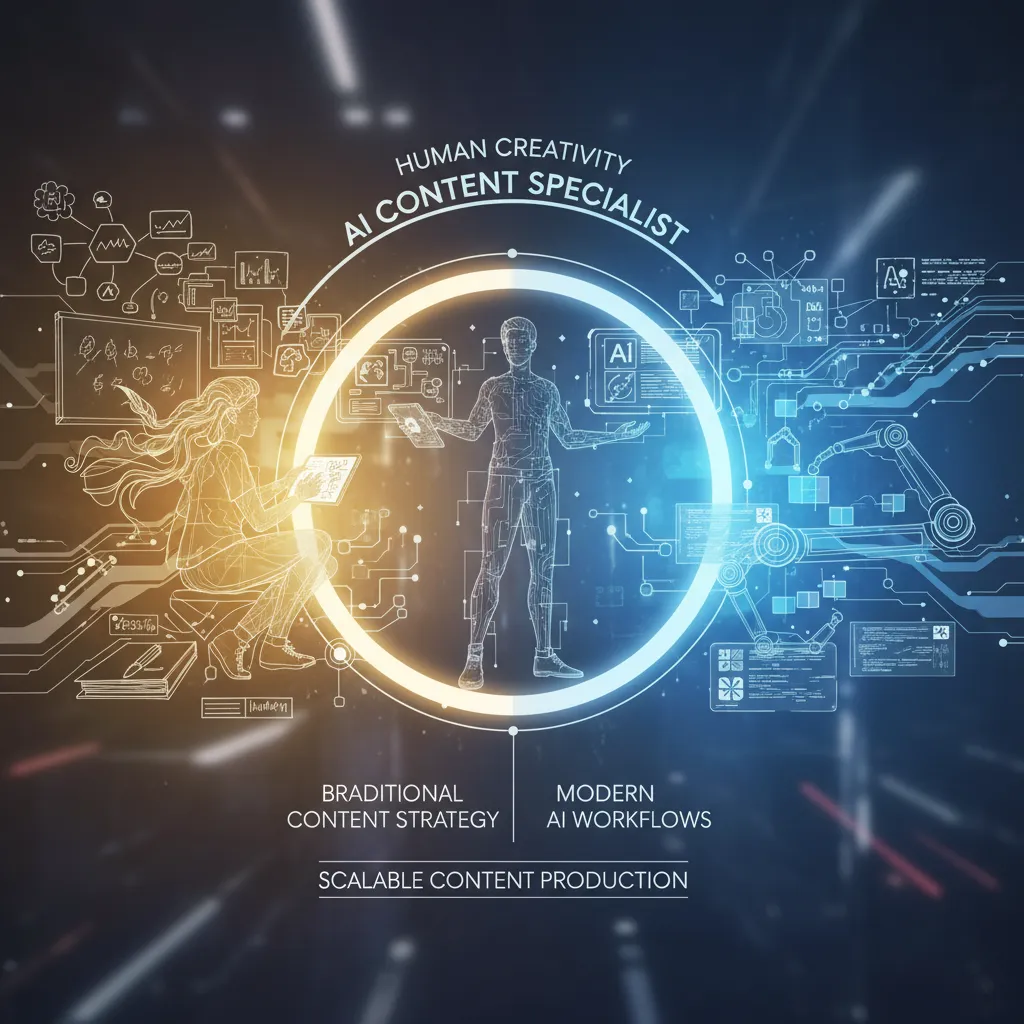
Let’s start with what an AI content specialist is not. It’s not someone who simply pastes prompts into a language model and publishes the output. It’s not a replacement for writers. And it’s not a technical role that requires coding skills (though some organizations blur that line).
What it actually is: a strategist who designs workflows to produce high-quality, consistent, on-brand content at scale using AI tools. The specialist understands how to structure prompts, manage content quality, maintain brand voice across dozens of pieces, and integrate AI output into broader marketing strategies.
In practice, the role looks like this:
- Prompt architecture: Building reusable prompt templates that produce consistent results. Not one-off ChatGPT queries, but frameworks that can be applied across multiple content types and topics.
- Workflow design: Creating systems where AI handles drafting, humans handle strategic review, and processes ensure nothing low-quality reaches the audience.
- Quality oversight: Reviewing AI-generated content for accuracy, brand alignment, factual errors, and tone consistency before publication.
- Tool integration: Understanding how different AI platforms, content management systems, and publishing tools work together.
- Performance analysis: Tracking which AI-generated content performs well and adjusting workflows based on data.
The role demands both creative and analytical thinking. You need to understand content strategy deeply enough to know when AI is appropriate and when human expertise is non-negotiable. You also need enough technical fluency to troubleshoot why a workflow isn’t producing consistent results.
How the AI Content Specialist Role Emerged
This position didn’t exist three years ago. It emerged for a specific reason: organizations realized they could produce more content, faster, but only if they had someone who understood both the creative requirements and the AI capabilities.
The first wave of hiring came from companies trying to scale blog production. A content team that previously published 8 posts per month suddenly needed to publish 40. Hiring 5 more writers wasn’t feasible. Switching entirely to AI-generated content was risky. So they hired someone who could design a hybrid process: AI drafts, humans refine, AI handles formatting and distribution.
The second wave came from SEO teams. As search algorithms increasingly rewarded content depth and topic clusters, teams needed to produce more interconnected content faster. An AI content specialist could help design systems to generate topic variations, internal linking suggestions, and content outlines at scale.
Now, the role is expanding into almost every marketing discipline. You’ll find AI content specialists in product marketing (generating use-case documentation), customer success (scaling support content), and demand generation (producing email sequences and landing page variations).
Core Skills Required for an AI Content Specialist
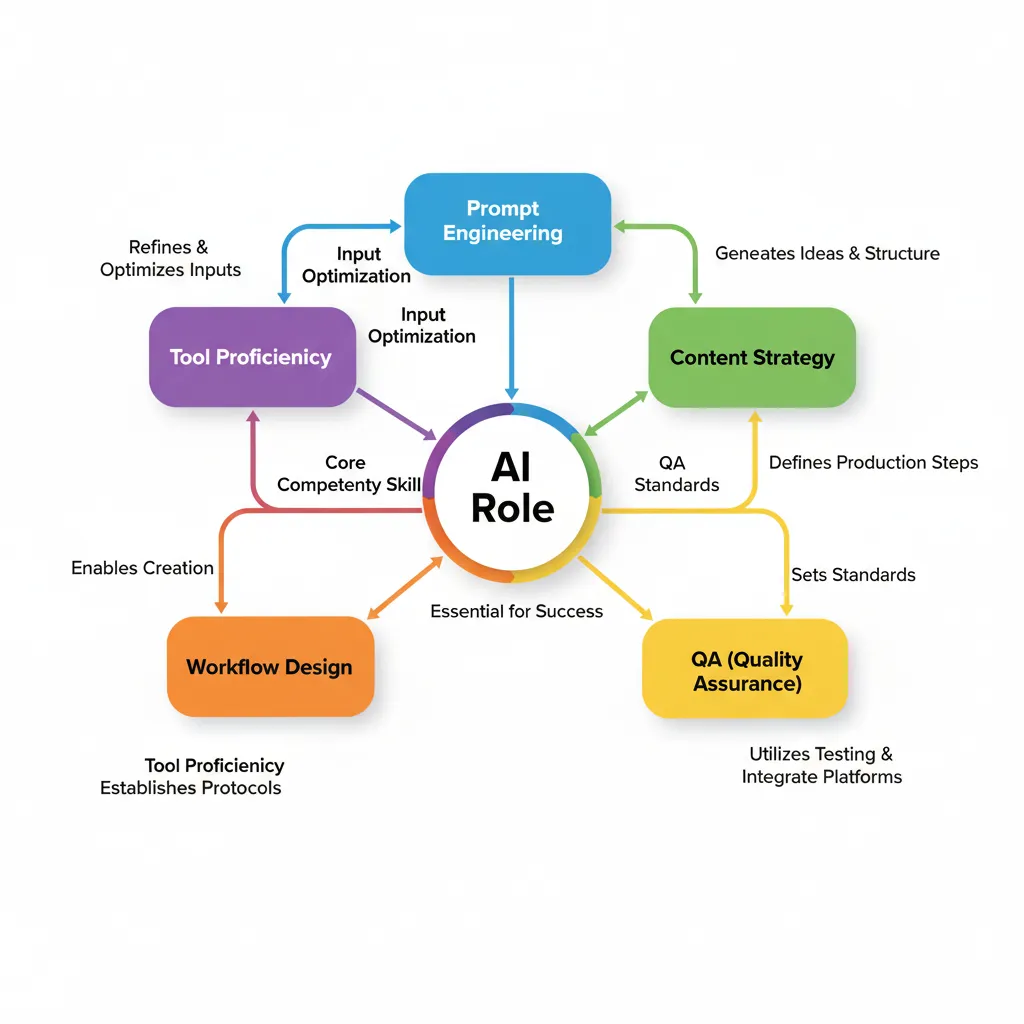
Most job postings list 5-10 required skills, but they vary wildly. Here’s what actually matters:
1. Prompt Engineering (But Not What You Think)
This doesn’t mean knowing obscure ChatGPT tricks. It means understanding how to structure instructions so an AI model produces consistent, usable output. You need to know:
- How to define output format clearly (JSON, markdown, specific structure)
- How to set constraints (word count, tone, audience level)
- How to provide context without overwhelming the model
- When to use few-shot examples and when they make things worse
- How different models (GPT-4, Claude, open-source LLMs) behave differently with the same prompt
Most people skip the last point and assume all models work the same way. They don’t. An AI content specialist knows these differences and adjusts workflows accordingly.
2. Content Strategy Understanding
You need to know content strategy at a level where you can make decisions about what should be AI-generated and what shouldn’t. This means understanding:
- SEO fundamentals (keyword research, topic clusters, search intent)
- Audience segmentation and messaging
- Content distribution channels and their different requirements
- How to measure content performance
Without this foundation, you’ll end up generating content that sounds good but doesn’t move business metrics. You’ll also struggle to explain to leadership why certain content shouldn’t be delegated to AI.
3. Quality Assurance and Brand Voice Management
This is where most AI content projects fail. The specialist needs to establish systems that catch:
- Hallucinations and factual errors
- Brand voice inconsistencies
- Tone mismatches for different audience segments
- Outdated or irrelevant information
- Plagiarism or excessive similarity to existing content
This requires building checklists, review processes, and sometimes tools that flag potential issues before human review.
4. Workflow and Systems Thinking
An AI content specialist should be comfortable designing processes. This might mean:
- Creating content briefs that feed into AI prompts
- Setting up approval workflows in content management systems
- Building feedback loops so the team learns what works
- Documenting processes so others can replicate them
This skill separates someone who uses AI from someone who can scale AI across a team.
5. Tool Proficiency
You don’t need to master every AI tool available. But you should be comfortable with:
- Large language models (ChatGPT, Claude, or equivalent)
- Your company’s content management or publishing platform
- Potentially a content automation service that connects AI output to distribution channels
- Basic spreadsheet or data work (CSV imports, simple formulas)
Most of these you can learn on the job. The mindset—being willing to experiment with new tools and adapt workflows—matters more than specific tool expertise.
Career Paths Into the AI Content Specialist Role
There’s no single path to becoming an AI content specialist. Most people transition into the role from adjacent positions:
From Traditional Copywriting or Content Marketing
This is the most common path. If you’ve been a content marketer or copywriter, you already understand audience, messaging, and content strategy. The transition involves learning to think in systems and workflows rather than individual pieces of content. You’re essentially asking: “How do I scale what I’ve been doing manually?”
The learning curve here is moderate. You’ll need to spend time with AI tools and understand their limitations, but you already have the strategic foundation.
From UX Writing or Product Content
UX writers often transition into AI content specialist roles because they’re already comfortable with constraints (limited space, specific user contexts, precise messaging). They understand tone and how small wording changes affect user behavior.
The gap is usually in scaling thinking. UX writers optimize for individual screens or flows. AI content specialists need to think about scaling across hundreds of pieces while maintaining consistency.
From SEO Specialist Roles
SEO specialists have a natural advantage: they already think in terms of data, keywords, and content clusters. They understand what content performs and why. Many SEO teams are now hiring AI content specialists specifically to scale topic cluster strategies.
The challenge is often the opposite of the UX writer path. SEO specialists need to develop stronger creative instincts and brand voice understanding.
From General Marketing Operations
Some people come into this role from marketing operations or marketing management backgrounds. They might not have deep content expertise, but they understand processes, tools, and how to manage workflows across teams.
This path requires more learning on the content strategy side, but these people often excel at building scalable systems because they’re comfortable thinking operationally.
What Makes Someone Actually Good at This Role
Job descriptions and skill lists don’t tell you what separates an adequate AI content specialist from a great one. Here’s what I’ve observed:
They’re skeptical of AI output by default. The best specialists don’t trust what the model produces without verification. They build review processes that assume something will be wrong. This paranoia prevents disasters.
They document everything. They create prompt templates, workflow diagrams, and decision trees that others can follow. This means their systems don’t fall apart when they take vacation or leave the company.
They measure obsessively. They don’t just generate content. They track which types of AI-generated content perform well, which topics consistently need heavy human revision, and where the workflow breaks down. They use this data to continuously improve.
They push back on unrealistic expectations. Mediocre specialists say “yes” to every request and produce mediocre content at scale. Good ones say “here’s what we can do well, and here’s what shouldn’t be automated.” This protects brand reputation.
They stay current with AI capabilities. The tools change monthly. New models emerge. Pricing shifts. Good specialists keep up. They experiment with new tools and understand when to switch or add new capabilities to their workflow.
The Reality of Hiring and Job Market Demand
Job boards show consistent demand for AI content specialists. Roles are open at companies ranging from early-stage startups to Fortune 500 enterprises. Salary ranges vary significantly based on location and company size, but the role is generally positioned as mid-level to senior.
What’s interesting is that many companies are struggling to fill these positions. Not because candidates don’t exist, but because the role is so new that candidates often don’t recognize themselves as qualified. A copywriter with 5 years of experience thinks they need to learn entirely new skills. An SEO specialist assumes they lack the creative background. An operations person thinks they’re not technical enough.
In reality, most people can transition into this role if they’re willing to learn. The barrier is usually confidence, not capability.
Scaling Content With AI: Where the Role Makes Real Impact
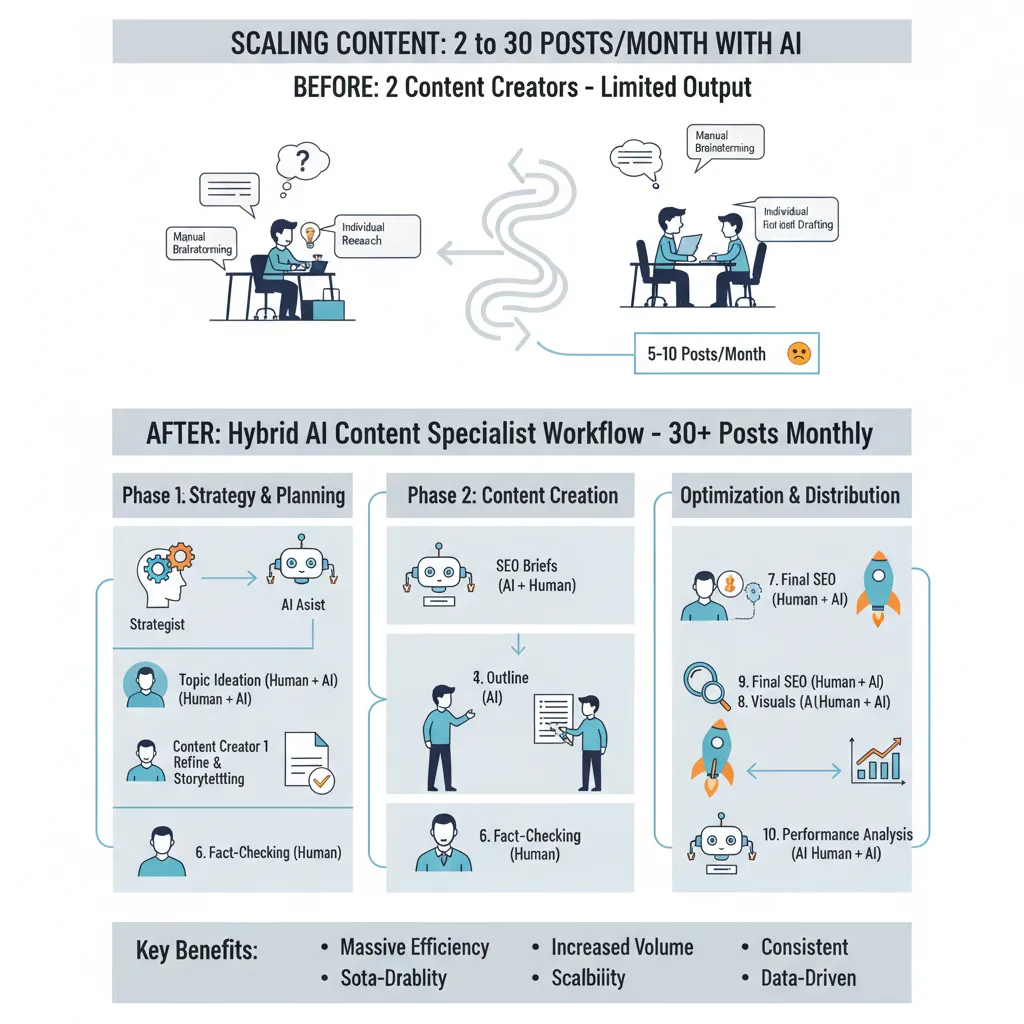
The reason this role exists is straightforward: organizations need to produce more content faster while maintaining quality. An AI content specialist makes this possible by designing systems that work.
Consider a typical scenario: a B2B SaaS company needs to publish 30 blog posts per month to maintain SEO visibility. Their content team is 2 people. Hiring 3 more writers would cost $200K+ annually. Switching entirely to AI-generated content risks brand reputation and search penalties.
An AI content specialist designs a workflow: AI generates 80% of the first draft based on detailed briefs and topic research. The human writer refines, adds examples, and ensures brand voice. Another human handles fact-checking and final review. The result: 30 posts per month with one additional hire instead of three.
This is the core value proposition of the role. It’s not about replacing writers. It’s about multiplying their output while maintaining standards.
The same logic applies to other content types. Product teams can scale documentation. Customer success can scale support articles. Marketing can scale email sequences and landing page variations. Each domain needs someone who understands both the content requirements and how to architect AI workflows for that specific use case.
Tools and Platforms Supporting AI Content Work
An AI content specialist works with several categories of tools:
Core AI models: ChatGPT, Claude, and other large language models form the foundation. Most specialists work with multiple models because they have different strengths.
Content management systems: Where the final content lives. WordPress, HubSpot, Contentful, or custom systems. The specialist needs to understand how content flows through these platforms.
Content automation platforms: Services that connect AI output to publishing systems, handle distribution across multiple channels, and provide analytics. These platforms can dramatically accelerate workflows by automating the repetitive parts of content production.
Quality assurance tools: Plagiarism checkers, fact-checking services, and readability analyzers. These help catch issues before publication.
Analytics and measurement: Tools that track content performance and provide feedback on what’s working. This data informs workflow improvements.
The specific tools matter less than understanding what each category does and how they fit together.
Common Mistakes AI Content Specialists Make
Most people starting in this role make predictable mistakes:
Treating AI as a replacement for strategy. You can’t prompt your way to a good content strategy. If your content plan is weak, AI will produce weak content faster. The specialist’s job is to enhance strategy execution, not replace strategic thinking.
Neglecting quality review processes. The easiest mistake to make is assuming AI output is good enough. It often isn’t. Building robust review processes takes time upfront but prevents costly mistakes later.
Underestimating the importance of prompt templates. Random, one-off prompts produce random, inconsistent results. Good specialists invest in building templates that work reliably across different topics and content types.
Ignoring brand voice consistency. AI models can match tone, but they need extremely clear guidance. Specialists who don’t establish explicit brand voice guidelines end up with content that technically sounds fine but doesn’t feel like it came from the same company.
Not measuring what matters. It’s easy to measure content volume. It’s harder to measure whether that content actually drives business results. Good specialists connect content metrics to business outcomes.
What’s Next: How to Position Yourself for This Role
If you’re interested in becoming an AI content specialist, here’s a practical path:
Start with your current role. You don’t need to switch jobs immediately. Experiment with AI tools in your current work. If you’re a writer, try using AI to generate first drafts and see what works. If you’re in operations, design a small workflow using AI and measure the results. If you’re in SEO, use AI to generate topic outlines and see how they perform.
Build a portfolio of small experiments. Document what you tried, what worked, what didn’t, and what you learned. This becomes your proof of capability when you interview for an AI content specialist role.
Get comfortable with the tools. Spend time with ChatGPT, Claude, and whatever other models your target companies use. Understand their strengths and limitations. Read about how they work, not just how to use them.
Study content strategy deeply. Read books on SEO, copywriting, and content marketing. Understand the principles that make content effective. This is what separates someone who prompts AI from someone who designs AI content systems.
Learn to think in systems. Practice documenting processes. Create templates. Build workflows. This is the core skill that makes you valuable as a specialist.
The role is new enough that there’s no standard interview process yet. Most companies are looking for evidence that you’ve thought deeply about AI content production and built something that works. A documented experiment you ran in your current role often impresses more than a degree or certification.
The Bigger Picture: Why This Role Matters Now
AI content specialists exist because we’re in a transition period. Content production is being fundamentally reshaped by AI capabilities. Teams that figure out how to use these capabilities effectively will outproduce competitors. Teams that don’t will fall behind.
The role is still evolving. In five years, it might look completely different. Some aspects might be automated away. New responsibilities might emerge. But right now, organizations need people who understand both content and AI workflows deeply enough to build systems that work.
For someone starting their career or looking to transition, this is an interesting time. The role is in high demand, the skill set is still being defined, and there’s room to shape what the position becomes.
Staying Ahead: Continuous Learning for AI Content Specialists
The AI landscape changes rapidly. New models release every few months. Capabilities improve constantly. An AI content specialist who learned everything last year is already behind.
Good specialists build learning into their workflow. They dedicate time each week to experimenting with new tools or models. They read about AI developments, even if they don’t directly apply to their current work. They participate in communities where people discuss AI content production.
They also stay grounded in fundamentals. The core principles of good content—clarity, relevance, audience understanding—don’t change when you add AI to the process. The specialist who remembers this avoids the trap of optimizing for AI output instead of human outcomes.
Frequently Asked Questions
Do I need a background in marketing to become an AI content specialist?
Not necessarily. A background in marketing, writing, or even operations can work. What matters is understanding content strategy and being comfortable with systems thinking. Most people can learn the content side if they have strong fundamentals in one of these areas.
Is this role the same as a prompt engineer?
No. Prompt engineers focus on getting the best output from AI models. AI content specialists focus on designing systems where AI output fits into a larger content strategy. Prompt engineering is part of the job, but it’s not the whole job.
Will AI content specialist roles disappear as AI improves?
Unlikely. As AI improves, the role will evolve, but the need for human oversight and strategic thinking will remain. The specialist role might shift from “making AI work” to “ensuring AI output aligns with strategy and brand,” but that’s still valuable work.
What’s the salary range for this role?
It varies widely by location and company size. In major tech hubs, expect $80K-$150K+ for mid-level positions. Senior specialists at large companies can earn significantly more. Startups might offer lower base salaries but with equity upside.
Can I do this role remotely?
Yes. Most of the work is digital and doesn’t require physical presence. Many companies hire AI content specialists remotely, though some prefer collaboration with the content or marketing team in person.
How do I know if I’m ready for this role?
If you can answer “yes” to most of these questions, you’re ready: Have you produced content at scale? Do you understand what makes content effective? Have you used AI tools and thought about their limitations? Can you design a process and document it clearly? Are you comfortable learning new tools quickly?
Building Your AI Content System: The Practical Next Step
If you’re building a team that needs to scale content production, or if you’re positioning yourself for an AI content specialist role, the next step is designing a system that actually works.
This means moving beyond random AI prompting into structured workflows. It means building templates that produce consistent results. It means establishing review processes that catch problems. It means measuring what works and iterating.
For teams looking to implement this, a content automation platform that connects AI capabilities to your publishing workflow can accelerate the process significantly. Rather than building custom integrations or managing workflows manually, these platforms handle the repetitive parts—prompt execution, content formatting, distribution across channels—so your team can focus on strategy and quality.
The best systems combine AI’s speed with human judgment. The AI content specialist’s role is designing that balance and ensuring it works reliably at scale.
Whether you’re hiring an AI content specialist or becoming one, the principle is the same: think systematically about how AI can enhance content production without replacing the human judgment that makes content effective.