AI Content Platform: Scale B2B Content Without Quality Loss

You’re stuck. Your team publishes one or two pieces a week. Your competitors seem to own half the first page of Google. And the pressure to “do more with less” is getting louder.
The temptation is to just pump out more content faster. But you know that won’t work—Google penalizes thin, low-effort stuff. So what’s the actual move?
It turns out, the highest-performing B2B teams aren’t choosing between speed and quality. They’re using an AI content platform as a force multiplier, not a replacement. And the numbers they’re getting aren’t small.
Key Takeaways
- Hybrid AI workflows (40% AI for research/optimization, 60% human for expertise) consistently deliver 89% top-10 ranking rates and 340% organic traffic growth
- Self-improving AI systems can 3x content performance without adding production time
- Voice-matched, AI-generated content on social can reach 1 million impressions monthly without sounding robotic
- Fully automated content operations are generating $200K+ monthly revenue for niche businesses
- The critical difference isn’t the tool—it’s having a repeatable system that combines AI speed with human judgment
The Real Problem With “Just Use AI”

Most teams that try to scale content with AI hit the same wall: the output feels hollow. Generic. Like it was written by someone who’s never actually done the thing they’re writing about.
Google knows this. So does your audience.
The 2024–2026 algorithm updates have made it clear that helpful, authoritative content wins. Slop loses. And there’s a massive difference between “content written by AI” and “content created by a human, optimized and accelerated by AI.”
One team of SEO practitioners figured this out early. They moved away from pure AI generation and built a hybrid workflow: AI handling research, outlining, draft generation, and SEO optimization—while humans stayed in charge of fact-checking, adding real experience, and ensuring every piece actually said something worth reading.
The result? They went from a content plateau to publishing 47 articles per month at 3.5 hours each. Eighty-nine percent of those articles ranked in the top 10. Time on page averaged 4.2 minutes. Bounce rate stayed below 25%. And the business pulled in $2.3 million from organic traffic alone, with a 23% lift in conversions.
Not luck. A system.
How the Best Teams Use an AI Content Platform
Here’s what separates the winners from the people still spinning their wheels:
They treat AI as a research and optimization layer, not a writer.
An AI content platform can instantly synthesize 50 sources, find gaps in existing content, suggest keyword clusters, and outline a piece in minutes. A human then takes that outline—which is already 40% of the work—and builds something with actual perspective.
The human adds the story. The specific example from last month. The thing that didn’t work and why. The nuance that makes the reader feel like they’re learning from someone who’s actually been there.
AI handles the parts that are mechanical: SEO structure, readability optimization, metadata, consistency checks, distribution formatting. Humans handle the parts that require judgment.
This split matters because it changes the economics. One practitioner built a custom AI content system that learned from its own output—getting better every single day—and managed to 3x performance without adding a single extra minute to the daily production schedule. Not 3% better. 3x.
The system was handling the repetitive optimization work. The team was handling the strategic thinking. Both were getting faster.
The Social Media Angle: Sounding Human at Scale
The same principle works on social, though most teams get it wrong.
You’ve seen the LinkedIn posts that are obviously AI-generated. They hit the same beats, use the same phrases, and feel like they were written by an algorithm that learned English from a marketing textbook.
One founder built a different approach. Instead of generic prompts, he used a hybrid method—training an AI system on his own voice, his own writing patterns, his own perspective. Then he had it generate content based on high-performing post formats, but in his actual voice.
The result: 13,500 followers, nearly 1 million impressions, and a flood of DM requests. Thousands of impressions every week. And people weren’t saying, “This sounds like AI.” They were saying, “This is useful.”
The key wasn’t the platform. It was the system: research the formats that work, generate variations in a specific voice, integrate lead capture, and let the volume do the work.
The Revenue Proof: When AI Content Becomes a Business
Some teams have taken this further and built entire businesses on the back of AI-optimized content.
One operation automated the entire workflow: niche selection, 2 posts per day, viral format cloning with AI, shoppable posts, auto-publishing. No human bottleneck. No daily production time added. Just a repeatable system that runs.
The monthly revenue? $203,871.
Is that the path for a B2B SaaS company? Probably not directly. But the principle is the same. The teams that are winning aren’t trying to automate away the human element. They’re automating everything around it so the human element has space to breathe.
They’re using an AI content platform to handle the parts that don’t need human judgment, so they can spend more time on the parts that do.
What Actually Matters When Choosing a Platform
The specific tool matters less than you think.
What matters:
- Research and outline speed. Can it synthesize 10+ sources and give you a structured outline in under 5 minutes? If not, it’s not saving you time where it counts.
- Voice consistency. Can it learn and maintain your brand voice across pieces? Generic AI sounds generic. Trained AI sounds like your team.
- SEO optimization built in. If you’re still manually checking keyword density, internal linking, and readability, the platform isn’t doing its job.
- Distribution integration. A piece that only lives on your blog is half-optimized. Can the platform help you adapt and publish to social, email, and other channels without rewriting?
- Learning from output. The best systems get better over time. They track what performs, what doesn’t, and adjust the next round accordingly.
Most platforms do some of these. The ones worth your time do most of them.
The Hybrid Model in Practice
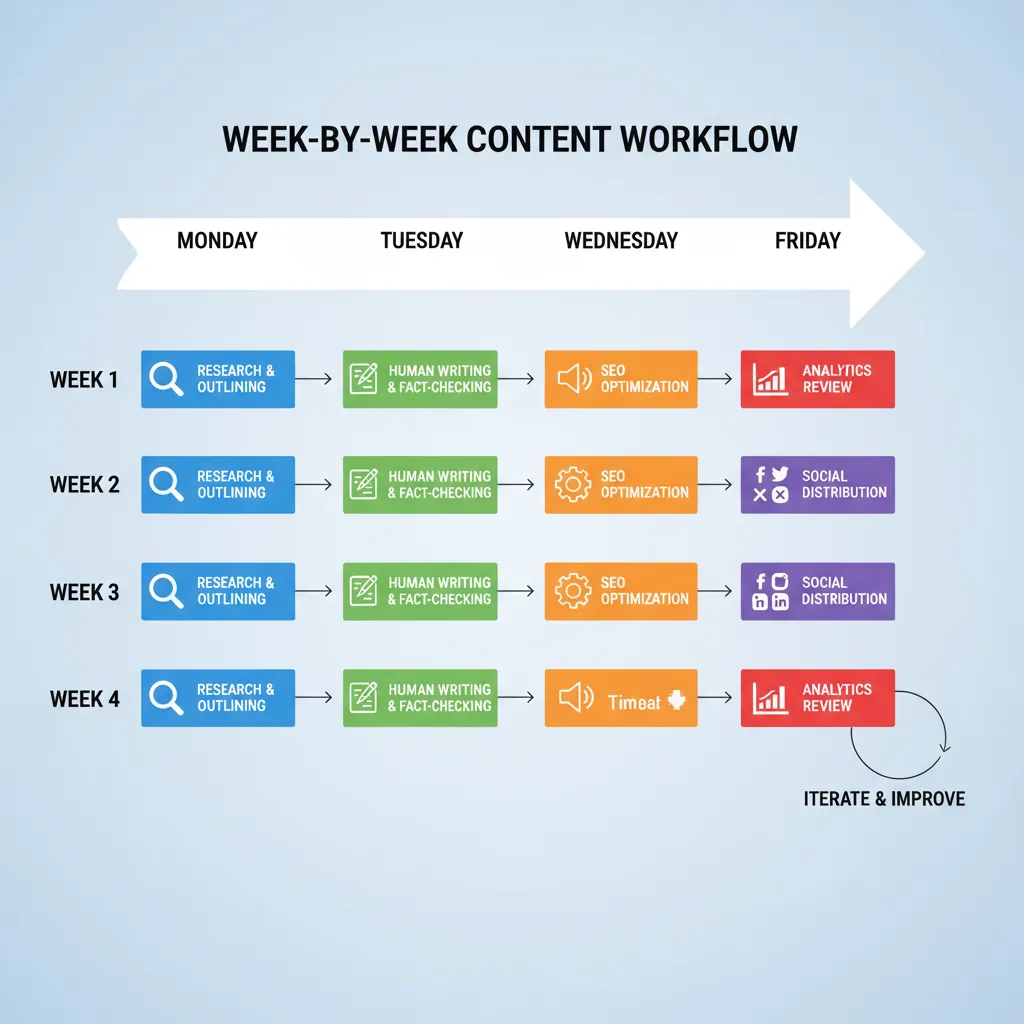
Let’s be concrete about what this actually looks like week to week.
Monday morning: Your team identifies 3 topics to cover. An AI content platform runs research on each, pulls competitor content, finds keyword gaps, and delivers three detailed outlines with source recommendations. Two hours of work that used to take eight.
Tuesday: Writers take those outlines and add their experience. They fact-check the AI’s research, add specific examples, and inject personality. Three hours per piece. The AI didn’t write the article—it wrote the skeleton.
Wednesday: The platform runs through SEO optimization. It checks internal linking opportunities, suggests meta descriptions, flags readability issues, and ensures keyword distribution is natural. The writer approves or adjusts. One hour total for all three pieces.
Thursday: The platform adapts each piece for social. It pulls key insights, generates headline variations, and formats for LinkedIn, Twitter, and email. The team picks the versions they like and schedules them. Thirty minutes.
Friday: Analytics come back on what performed. The system logs it. Next week, it’ll suggest similar angles based on what worked.
Total time invested: roughly 12 hours for three pieces that are going to get published across six channels, optimized for search, and tracked for performance.
That’s the math that changes everything.
The Quality Question: Does AI-Assisted Content Rank?
Yes. Emphatically yes.
The 89% top-10 ranking rate from that SEO team didn’t happen because they were using AI. It happened because they used AI strategically—to handle the parts that are purely mechanical—and kept humans in charge of the parts that require judgment.
Google’s helpful content updates reward depth, authority, and experience. An AI platform can’t write those things. But it can handle research, structure, optimization, and distribution so thoroughly that your human experts have time to actually add depth, authority, and experience instead of drowning in logistics.
The conversion lift (23% in that case) didn’t come from better AI. It came from better content. The AI just made it possible to produce better content consistently.
Here’s the thing most people miss: AI didn’t make content easier. It made it possible to do content the right way at scale. The right way is slower than pure automation. But it’s faster than doing it all manually. And it actually works.
Common Mistakes Teams Make
Most teams that try this get at least one thing wrong:
Mistake 1: Trusting the first draft. An AI content platform’s output is a starting point, not a finished piece. Teams that publish without human review get caught by thin content penalties. The ones that win treat AI output as a 40% first pass, not 90% of the work.
Mistake 2: Ignoring voice. Generic AI sounds generic. The best teams spend time training their platform on their actual voice, their actual perspective, their actual way of explaining things. Then the output sounds like their team, just faster.
Mistake 3: Optimizing for volume instead of signals. Forty-seven articles a month only works if they’re actually good. The winning teams track time on page, bounce rate, conversions, and ranking velocity. They’re not just counting pieces published. They’re measuring whether those pieces are actually moving the needle.
Mistake 4: Forgetting distribution. An article that only lives on your blog is half-optimized. The best platforms help you adapt and republish to social, email, and other channels. One piece of research can become six pieces of content across six channels.
Mistake 5: Setting it and forgetting it. AI systems improve when you feed them data. The teams that win are constantly checking what worked, what didn’t, and adjusting the next round. They treat the platform as a learning system, not a content vending machine.
The Economics: When Does This Actually Pay?
An AI content platform isn’t free. Neither is the time to use it properly.
But the math works fast:
- If you’re currently producing 4 pieces per month and want to get to 12, an AI platform saves you roughly 40 hours per month in research and optimization. At $50/hour (loaded cost of a mid-level content person), that’s $2,000 per month in efficiency gain.
- If those 12 pieces generate even one extra qualified lead per month (conservative), and your deal size is $50K+, you’ve paid for the platform and the time investment 25 times over.
- If you’re running paid ads and organic traffic is your channel, the ROI math is even better. One piece that ranks and converts is worth thousands in ad spend.
The payoff isn’t theoretical. Teams are seeing 340% organic traffic growth, $2.3M in annual revenue from organic, and 23% conversion lifts. Those aren’t edge cases. Those are what happens when you use AI strategically instead of trying to automate away the human element.
What to Look For in an AI Content Platform
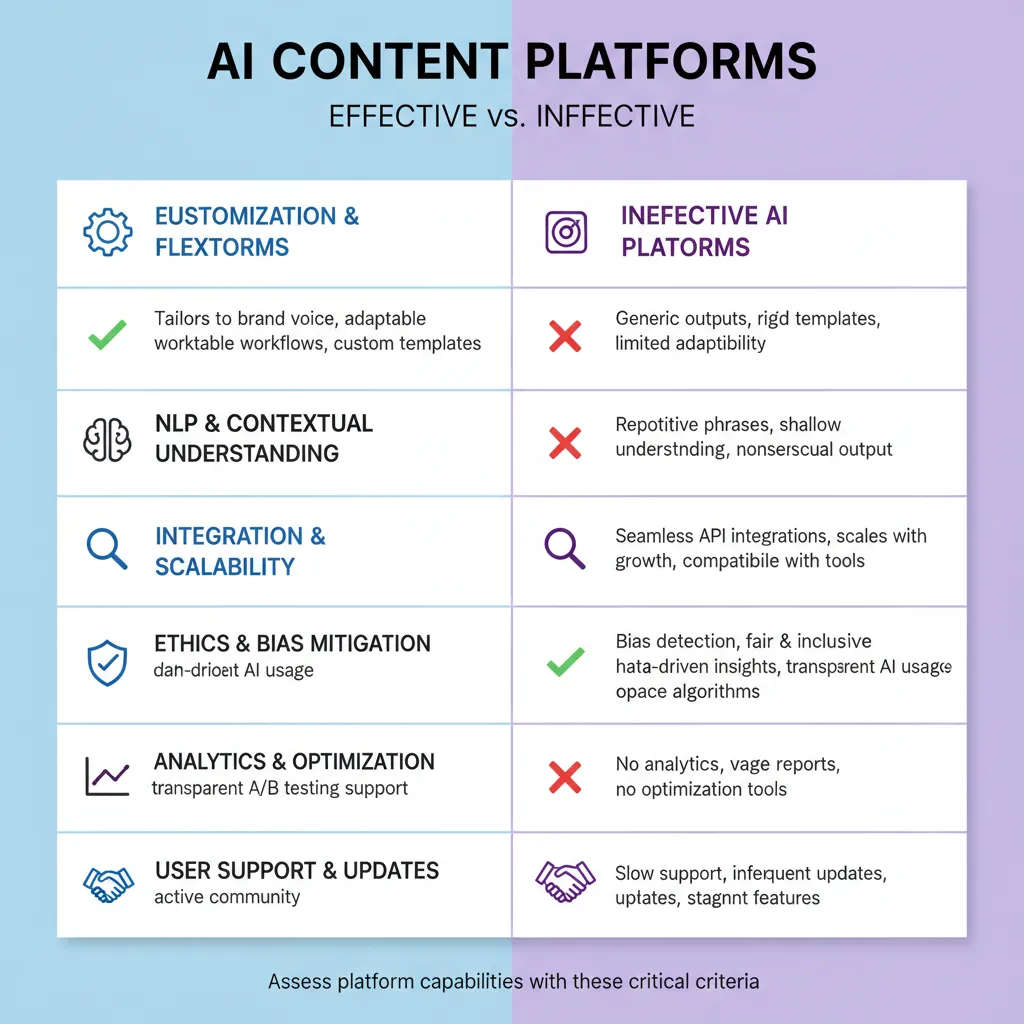
Not all platforms are built the same way. Here’s what separates the tools that actually work from the ones that are just riding the AI hype:
Research and synthesis. Can it pull from 10+ sources and give you a structured outline? Or does it just generate text based on a prompt? The former saves time. The latter wastes it.
SEO integration. Is keyword optimization built in, or are you manually checking every piece? Is internal linking suggested? Are readability scores automatic? If you’re still doing SEO work manually, the platform isn’t doing its job.
Voice training. Can you teach it your brand voice? Or does everything come out sounding generic? The winning teams use platforms that adapt to their perspective, not platforms that override it.
Distribution and adaptation. Can it help you turn one piece into six—blog post, LinkedIn carousel, Twitter thread, email, short-form video script? Or are you rewriting for each channel? The former saves 10 hours per piece.
Analytics and learning. Does it track what performs and adjust future recommendations? Or is every piece starting from scratch? Systems that learn are systems that get better.
Human workflow integration. Does it work with your actual process, or does it require you to change everything? The best platforms fit into how you already work, not the other way around.
Building Your Content System
If you’re thinking about moving toward this model, here’s how to start without blowing up what’s already working:
Phase 1: Audit and baseline. How many pieces are you publishing per month? How long does each take? What are your current traffic and conversion metrics? You need a before picture.
Phase 2: Pick one workflow. Don’t try to change everything at once. Pick your biggest bottleneck. Is it research? Is it SEO optimization? Is it distribution? Start there.
Phase 3: Introduce the platform to that workflow. Don’t expect it to work perfectly on day one. Spend two weeks tuning it. Train it on your voice. Adjust the prompts. Get it to the point where the output is actually saving you time instead of creating more work.
Phase 4: Measure the impact. Are you publishing faster? Is the quality holding? Are the pieces ranking? Are they converting? If yes to three of those four, expand to the next workflow. If no, adjust the system before you scale it.
Phase 5: Scale and systematize. Once one workflow is working, replicate it. Add more topics. More pieces. More channels. The system gets better the more you use it.
The teams that are seeing 340% traffic growth didn’t get there by accident. They built a system. They tested it. They measured it. They scaled it.
The Future of Content: AI as Infrastructure
The question isn’t whether AI will be part of your content strategy. It already is. Every search engine is using AI to rank content. Every platform is using AI to recommend content. Every competitor is using AI to produce content.
The question is whether you’re using it strategically or whether you’re falling behind because you’re not.
The teams winning right now aren’t the ones trying to automate away human judgment. They’re the ones using AI to handle the mechanical parts so their human experts have time to actually think, research, and create.
They’re using an AI content platform as infrastructure—like a CMS or an analytics tool—not as a content writer.
And the results are speaking for themselves: 89% top-10 rankings, 340% traffic growth, 3x performance improvements, $200K+ monthly revenue from content-driven businesses.
That’s not hype. That’s what happens when you build the system right.
Getting Started: The Next Step
If your team is stuck publishing 4–6 pieces per month and you know you need to scale, the first move isn’t to panic-hire more writers. It’s to get smarter about the work you’re already doing.
That’s where a platform like TeamGrain comes in. It’s built specifically for teams that need to publish consistently without sacrificing quality. It handles research, SEO optimization, voice training, distribution, and analytics—the infrastructure layer that lets your team focus on the thinking and creating.
You don’t need to change how you work. You just need the right tool to make your current process faster and more measurable.
Start with one workflow. Measure the impact. Scale from there. That’s how you go from a content bottleneck to a competitive advantage.
FAQ: AI Content Platforms
Q: Will Google penalize content made with an AI content platform?
A: Not if it’s good. Google doesn’t care how content is made. It cares whether it’s helpful, accurate, and authoritative. An AI platform can help you produce better content faster. It can’t make bad content good.
Q: How much time does an AI content platform actually save?
A: Depends on the workflow. Research and outlining: 60–70% time savings. SEO optimization: 80–90%. Distribution: 70–80%. Writing itself: 20–30% (AI can draft, but human editing is still necessary). Overall, most teams see 40–50% time savings per piece when used properly.
Q: Can you use an AI content platform without hiring a content person?
A: Technically yes. Practically, no. The platform handles the mechanical parts. But someone still needs to research topics, fact-check, add perspective, and decide what’s worth publishing. That someone doesn’t need to be full-time, but they need to exist.
Q: What’s the difference between an AI content platform and ChatGPT?
A: ChatGPT is a chat interface. An AI content platform is a system designed for content workflows. It includes research, SEO optimization, voice training, distribution, analytics, and integration with your publishing process. ChatGPT is a tool. A content platform is infrastructure.
Q: How do you keep AI-generated content from sounding robotic?
A: Train it on your voice. Feed it examples of your best writing. Adjust the prompts. Most importantly: have a human edit everything. The platform generates structure and optimization. The human adds personality and judgment.
Q: What ROI should I expect?
A: If you’re currently publishing 4 pieces per month and scale to 12 with no quality drop, and your content generates even one extra lead per month, you’re looking at 10–25x ROI depending on your deal size. Real teams are seeing 23% conversion lifts and 340% traffic growth. Those are the benchmarks.