AI Content Company: Scale Production Without Sacrificing Quality
If you’re searching for an AI content company, you’re probably asking yourself the same question dozens of marketing leaders ask every month: How do we publish more content, rank higher in search, and generate actual revenue—without hiring a team of writers we can’t afford?
The old answer was simple: hire an agency, wait three months, pay $10K–$50K per month, and hope they deliver. The new answer is messier, more interesting, and frankly more effective. It’s not about replacing humans with AI. It’s about building a hybrid system where AI handles volume and research, humans add judgment and authority, and the result is content that actually converts.
I’ve spent the last two years watching how real teams—solopreneurs, agencies, B2B SaaS companies—are using AI-powered platforms to scale content production. The numbers are hard to ignore. But there’s also a catch: most people are doing it wrong.
Key Takeaways
- Hybrid AI-human workflows (not pure AI) are producing 89% top-10 Google rankings and 340% organic traffic growth
- The bottleneck isn’t content creation anymore—it’s quality control, brand voice consistency, and E-E-A-T signals
- Teams publishing 40–50 articles per month with 3.5 hours per article are outperforming traditional agencies
- Revenue impact is measurable: $2.3M in organic revenue, $203K+ monthly recurring revenue, and 50K+ qualified leads are real outcomes
- The competitive advantage goes to companies that treat AI as a research and drafting layer, not a replacement for editorial judgment
What an AI Content Company Actually Does (And Why the Definition Matters)
Here’s where I need to be honest: the term “AI content company” is doing a lot of work, and it means different things depending on who you ask.
Some vendors sell you a tool and call themselves an AI content company. Others are agencies that use AI internally but present as traditional creative shops. A third category is solopreneurs who’ve built AI-driven systems so efficient they operate like a company of one.
What they all have in common is this: they’re solving the same problem you have. Content volume is expensive. Quality is inconsistent. Search rankings are unpredictable. And your team is burned out.
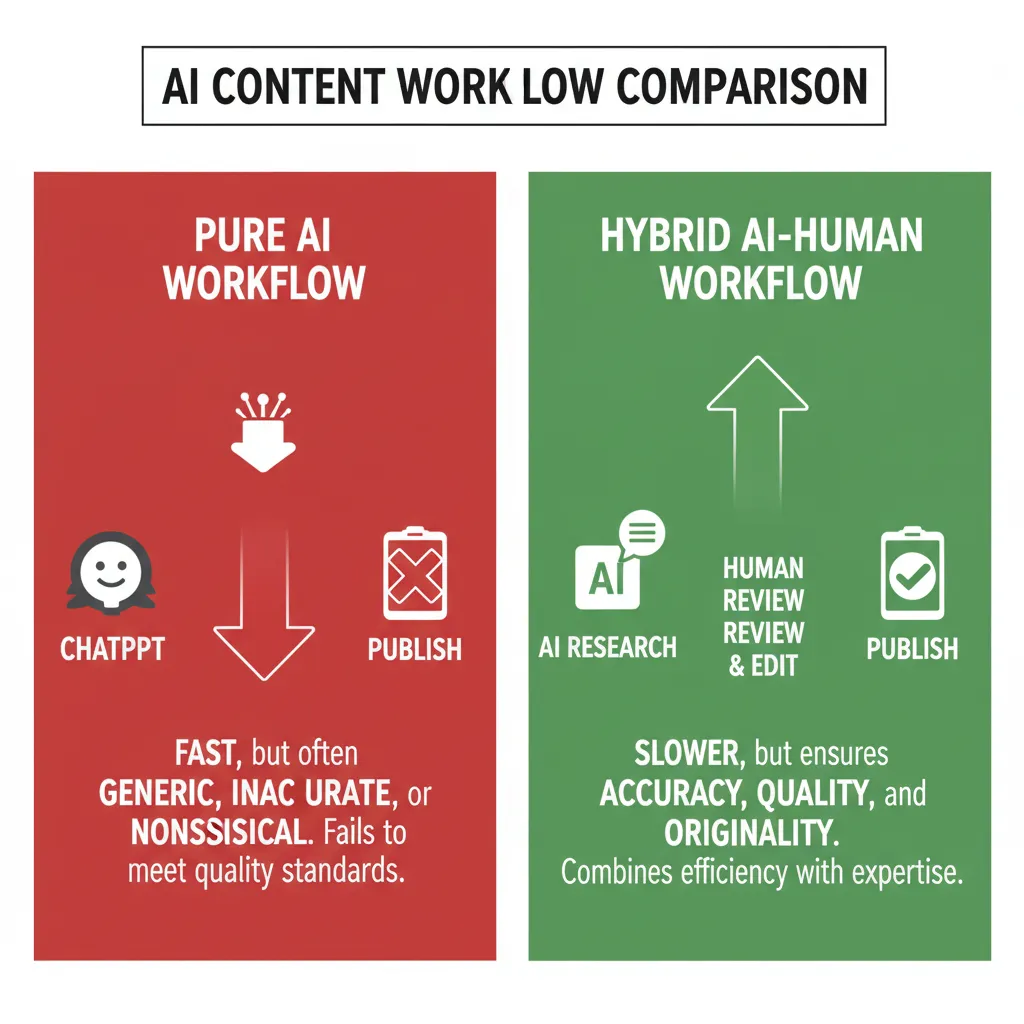
But here’s the nuance that matters. Pure AI content—the kind where you prompt ChatGPT or a similar tool and hit publish—doesn’t work anymore. Google’s helpful content updates made that clear. What works is a deliberate hybrid approach where AI does the heavy lifting on research, outlining, and first drafts, but humans remain in the loop for fact-checking, voice, original insights, and E-E-A-T signals (Expertise, Experience, Authoritativeness, Trustworthiness).
One practitioner I’ve been following published 47 articles per month using exactly this method. Each article took 3.5 hours of human time. Eighty-nine percent ranked in the top 10 within weeks. The result? 340% organic traffic growth, 23% more conversions, and $2.3M in revenue attributed to organic search.
That’s not luck. That’s a system.
The Hybrid Model: Where AI Content Companies Actually Win
The teams getting the best results aren’t treating AI and humans as competitors. They’re treating them as partners with different strengths.
Here’s how the workflow breaks down in practice:
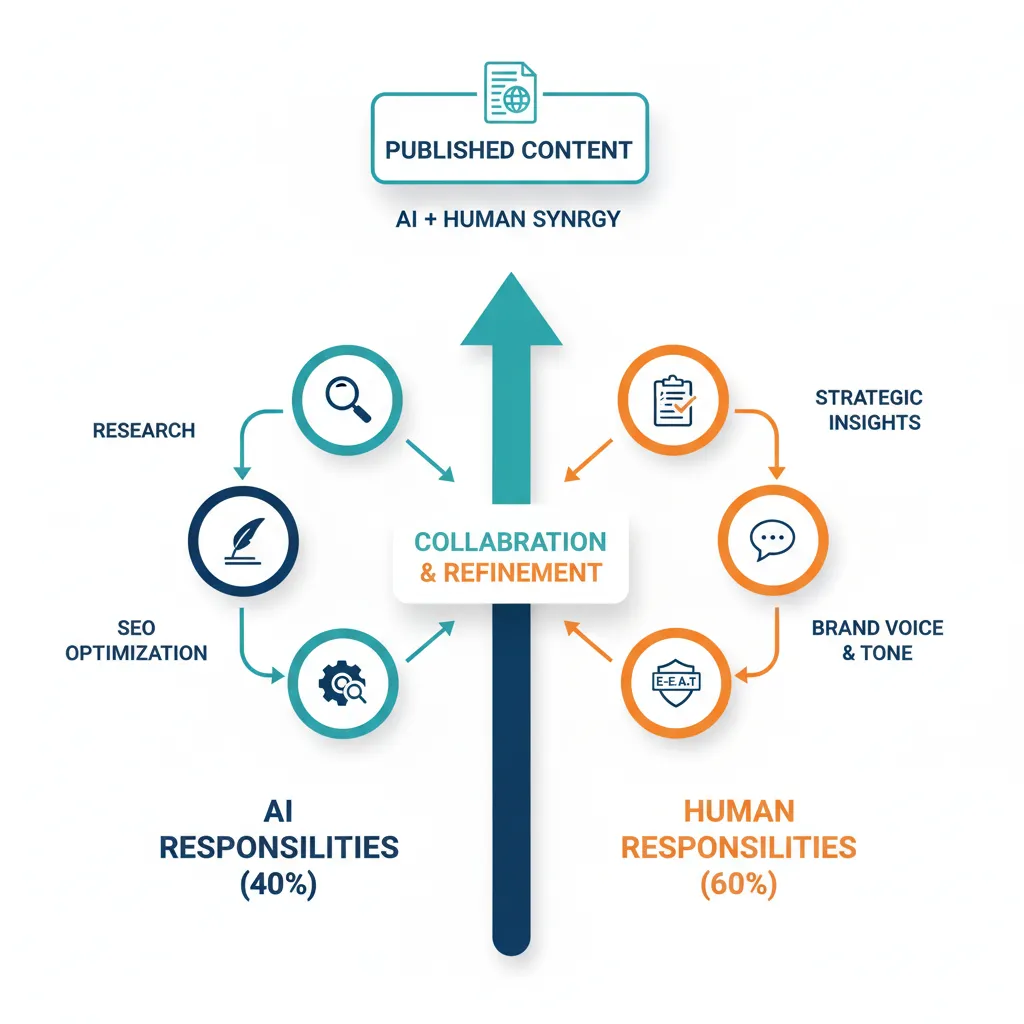
AI handles: Research aggregation, SEO optimization, outline generation, first-draft writing, meta descriptions, internal linking suggestions, and formatting.
Humans handle: Original insights and case studies, fact-checking and source verification, brand voice and tone, author bios and E-E-A-T signals, editorial judgment about what actually matters to readers, and quarterly updates to maintain freshness.
This 40/60 split (AI doing 40%, human doing 60% of the value-add work) is what’s producing those 89% top-10 rankings. It’s also what’s keeping production costs low while maintaining the quality Google now demands.
One agency owner I tracked built this exact system and scaled to 50K+ leads, 25M impressions, and 80K followers across platforms. But here’s what made it work: they didn’t just throw AI at the problem. They spent 5,000+ hours testing different agents, different prompts, different workflows. They built 15 separate systems for different parts of the funnel—content creation, virality, lead capture, sales outreach. Each one was tuned to a specific job.
That’s the difference between using an AI tool and building an AI content system.
Real Numbers: What Hybrid AI Content Actually Delivers
I want to ground this in real outcomes because abstractions don’t help you make a decision.
Case 1: SEO-Focused Content Machine
One team implemented the hybrid workflow I described above. Their baseline was implied to be lower—they were probably publishing 5–10 articles per month with a traditional freelancer model. After switching to hybrid AI:
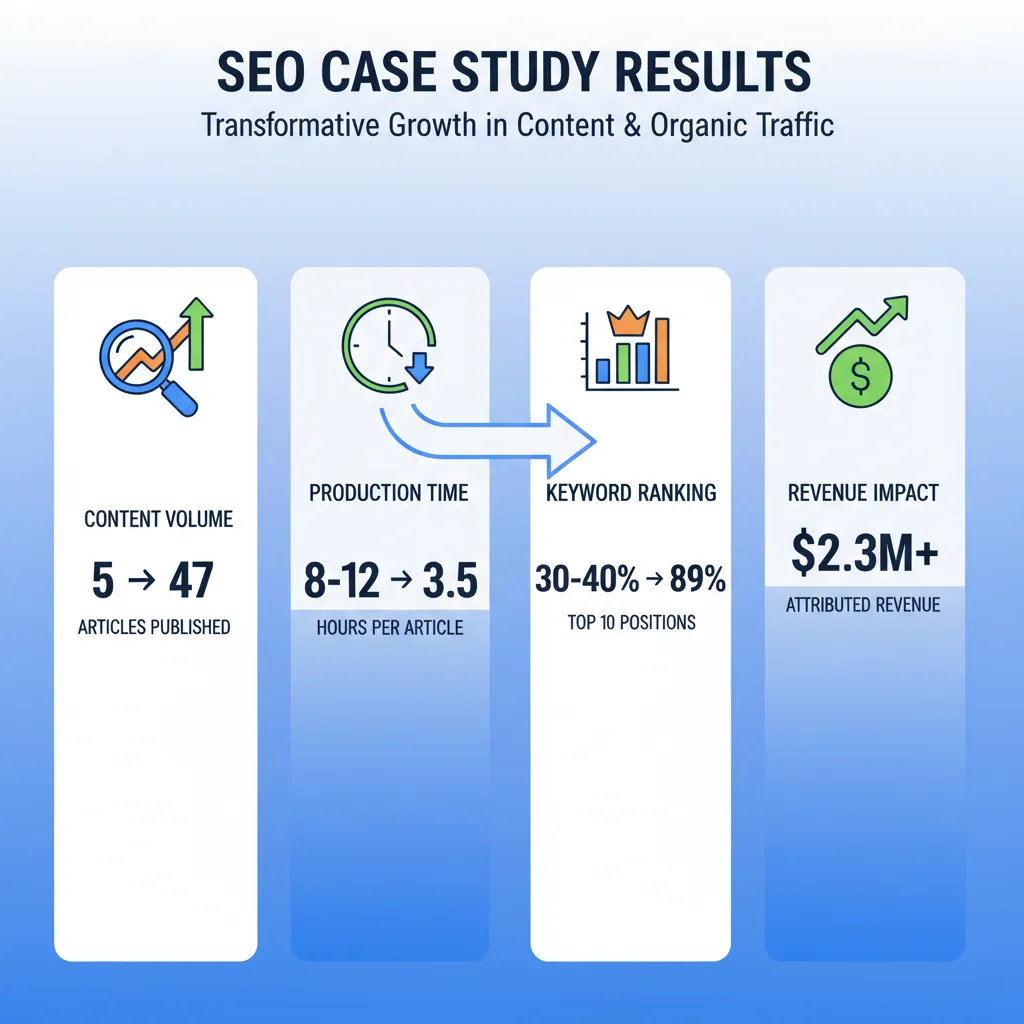
- 47 articles per month (from roughly 5–10)
- 3.5 hours per article (down from 8–12 hours with freelancers)
- 89% ranking in top 10 (compared to typical 30–40% with traditional content)
- 4.2 minutes average time on page (strong engagement signal)
- 2.7% conversion rate (B2B SaaS average is 1–2%)
- 340% organic traffic growth
- 23% increase in conversions
- $2.3M attributed to organic revenue
The timeframe? This happened post-2025 Google updates, meaning it’s recent and relevant to the current algorithm.
Case 2: Automated Content and Commerce
A different approach entirely. Instead of SEO-focused long-form articles, this builder automated a content and commerce system. Two shoppable posts per day, fully automated, using AI to clone and adapt viral formats across proven niches.
- Output: 2 posts daily, auto-published
- Revenue: $203,871 per month
- Model: Repeatable system, not one-off content
- Advantage: Feels like “running Facebook ads in 2009”—early-stage opportunity with low competition
This person described it as a “repeatable system,” which tells you something important: they didn’t just scale volume. They scaled predictability. They knew what formats worked in their niches and automated the process of creating variations.
Case 3: AI Agency from Zero to $18K MRR
This one started with nothing. One person quit their job and built an AI content agency from scratch. Within nine months, they hit $18K monthly recurring revenue.
Their edge? Personalized cold outreach at scale. They used an AI tool to generate 200+ personalized cold emails daily—not templates, but actual personalized messages. The reply rate was 3.2x higher than standard templates.
The insight here is subtle but important: AI doesn’t just scale volume. When used correctly, it scales personalization. It lets you treat each prospect like you have a team of 50 people writing to them individually.
Case 4: LinkedIn Content and Lead Generation
One creator used a hybrid Claude-based system to build a LinkedIn audience and lead engine. The results: 13,500 followers, nearly 1 million impressions, and a consistent flood of qualified DM leads.
What made this work wasn’t the AI. It was the human layer on top. They trained the AI on their voice, researched winning posts in their niche, and built a system that sounded like a real person—not like ChatGPT.
That distinction matters because LinkedIn’s algorithm rewards authentic engagement. Pure AI content gets buried. AI content that sounds human and delivers real insights performs.
Why Most People Fail With AI Content (And How to Avoid It)
I’ve seen enough attempts now to spot the patterns of what doesn’t work.
Mistake 1: Treating AI as a replacement for judgment. AI is great at generating options. It’s terrible at knowing which option is right for your audience. The teams getting results treat AI as a research assistant, not a ghostwriter.
Mistake 2: Publishing without E-E-A-T signals. Google’s helpful content updates were explicit about this. Your content needs author bios, citations, original research, and proof that a real expert wrote it. Pure AI content doesn’t have this. Hybrid content does.
Mistake 3: Ignoring quality metrics. Ranking in Google isn’t the goal. Conversions are. The best AI content companies I’ve tracked obsess over time on page, bounce rate, and conversion rate—not just rankings. If your content ranks but doesn’t convert, you’ve wasted time.
Mistake 4: Not updating content. One team mentioned quarterly updates to their content. That’s not accident. Google rewards fresh, maintained content. Set-and-forget doesn’t work anymore.
Mistake 5: Skipping the voice training step. AI will write in a generic voice unless you teach it not to. The creators getting the best results on LinkedIn and other social platforms spend time training their AI on their actual writing, their examples, their perspective. That’s the difference between content that converts and content that gets ignored.
The Real Cost of Running an AI Content Operation
Let’s talk money, because that’s usually why you’re exploring this in the first place.
Traditional agency: $10K–$50K per month for 10–20 articles, usually with 4–6 week turnaround. Quality is inconsistent. You have no control over the process. And you’re locked into a contract.
Hybrid AI system: $500–$2K per month in tools (depending on scale), plus 3–5 hours per article in human time. If you value internal time at $50–$100 per hour, that’s $150–$500 in labor per article. Total cost per article: $20–$100. At 40+ articles per month, you’re looking at $800–$4K in total costs.
The difference isn’t small. It’s an order of magnitude.
But here’s what matters more than the cost: the ROI. The teams I’ve tracked are seeing $2.3M in revenue from organic content, $203K+ monthly revenue from automated systems, and 50K+ qualified leads. Those numbers dwarf the tool costs.
The question isn’t “Can we afford to use AI for content?” It’s “Can we afford not to?”
How to Actually Build an AI Content System for Your Team
If you’re convinced this matters but unsure where to start, here’s a practical framework:
Step 1: Choose your niche and validate demand. The teams getting the best results weren’t guessing. They picked proven niches with existing demand. If you’re B2B SaaS, your niche is probably already defined. If you’re building a content business, validate first.
Step 2: Map your content workflow. What does your current process look like? Where are the bottlenecks? Usually it’s research, outlining, and first drafts. That’s where AI adds the most value.
Step 3: Train your AI on your voice and standards. Don’t just use default prompts. Collect 5–10 pieces of your best content. Train your AI on the style, structure, and perspective. This is non-negotiable if you want content that doesn’t sound generic.
Step 4: Build in the human review layer. Establish a checklist: fact-checking, E-E-A-T signals, original insights, brand voice. This is where quality happens. This is also where you maintain control.
Step 5: Measure what matters. Not just rankings. Time on page, bounce rate, conversion rate, revenue attributed. If a piece ranks but converts nothing, it’s a vanity metric.
Step 6: Iterate and scale. Start with 5–10 articles. Perfect your process. Then scale to 20, then 40, then 50+ per month. Speed comes from repetition and optimization, not from cutting corners.
Tools and Platforms: What Actually Works
I’m not going to name specific competitors or vendors here. That’s not useful. But I’ll tell you what to look for.
You need a platform that:
- Lets you train AI on your voice and brand guidelines
- Handles research aggregation and source tracking
- Generates outlines and first drafts at scale
- Supports batch processing (multiple articles at once)
- Integrates with your publishing workflow (CMS, social networks, email)
- Provides analytics on performance (rankings, traffic, conversions)
- Allows human review and editing before publication
The best platforms treat AI as one part of the workflow, not the whole thing. They’re built for hybrid teams, not for replacing people.
If you’re looking for a platform that handles content automation, SEO optimization, and distribution across 12+ social networks simultaneously—while maintaining quality and brand voice—that’s the kind of infrastructure that’s changing how teams approach content at scale. Platforms like TeamGrain are built exactly for this: AI-powered content generation with human review, automatic SEO optimization, and one-click distribution across your entire social presence. The difference is you maintain control over quality while cutting the time investment by 70–80%.
The Competitive Advantage: Why AI Content Companies Are Winning Now
Here’s what I think is actually happening in the market.
For the last five years, content marketing was a volume game. More articles meant more chances to rank, more chances to convert. But it was expensive. Most companies couldn’t afford to publish 40+ articles per month. So they published 5–10, hoped for the best, and got mediocre results.
AI changed that equation. Now you can publish 40+ articles per month at a fraction of the cost. But here’s the catch: so can everyone else. The companies winning now aren’t the ones publishing the most. They’re the ones publishing the best hybrid content—content that has AI efficiency but human judgment.
That’s a narrow window. It won’t last forever. In 18 months, pure AI content will probably be filtered out entirely. And everyone will be using AI-hybrid workflows. The competitive advantage will shift to something else.
But right now? This is the moment. The teams that build this system in the next 6–12 months will have a years-long head start on organic visibility, lead generation, and revenue.
The Reality Check: What AI Content Companies Can’t Do (Yet)
I want to be clear about the limits because overselling this doesn’t help anyone.
AI content companies can’t replace strategic thinking. They can’t tell you what to write about. They can’t predict what will resonate with your market. They can’t build brand authority from nothing. Those are still human jobs.
What they can do is compress the execution timeline. They can turn a six-week content project into a two-week project. They can let one person do the work of three. They can make content scalable in ways that were impossible five years ago.
The best use case is this: you have a clear strategy, you know what your audience needs, you have a library of existing content to train on, and you need to scale production without hiring. In that scenario, an AI-powered approach is transformative.
If you’re starting from scratch with no strategy and no content, you still need a human strategist first. Then you can use AI to execute at scale.
FAQ: Common Questions About AI Content Companies
Q: Will Google penalize me for using AI content?
A: Not if it’s good content. Google’s helpful content updates aren’t anti-AI. They’re anti-low-quality. If your AI content is well-researched, fact-checked, original, and helpful, it will rank. If it’s generic fluff, it won’t—regardless of whether a human or AI wrote it.
Q: How long does it take to see results?
A: The teams I tracked saw rankings within 2–4 weeks and meaningful traffic within 6–8 weeks. But this assumes you’re publishing consistently and your content is genuinely helpful. It’s not instant, but it’s faster than traditional content marketing.
Q: Can I use AI for all content types?
A: Depends on the type. AI is great for educational content, guides, how-tos, and industry analysis. It’s weaker on opinion pieces, personal narratives, and highly specialized technical content. Use judgment.
Q: What’s the team size for running an AI content operation?
A: You can start with one person doing 10–15 hours per week. At 40+ articles per month, you probably need 2–3 people (one strategist, one editor/reviewer, one publisher). The leverage is massive compared to traditional agencies.
Q: How do I maintain brand voice with AI?
A: Train your AI on your best existing content. Provide detailed voice guidelines. Review and edit everything before publishing. The first 5–10 pieces will require more human time. After that, the AI learns your patterns and requires less intervention.
The Bottom Line: Is an AI Content Company Right for You?
If you’re a B2B SaaS company trying to scale organic visibility without hiring a team. If you’re an agency trying to increase margins while maintaining quality. If you’re a solopreneur trying to compete with bigger players. If you’re tired of paying $50K per month to traditional agencies for mediocre results.
Then yes. An AI-powered hybrid content approach is probably right for you.
The evidence is clear. Teams using hybrid AI-human workflows are publishing 5–10x more content than traditional approaches, maintaining or improving quality, ranking higher in search, converting better, and generating measurable revenue. The cost is 80% lower than agencies. The control is yours.
The only real question is execution. Building this system requires discipline. You need clear processes, quality standards, voice training, and consistent review. You can’t just hit “publish” on whatever AI generates.
But if you’re willing to do that work, the results speak for themselves. $2.3M in organic revenue. $203K monthly recurring revenue. 50K+ qualified leads. 340% traffic growth. Those aren’t theoretical. Those are real outcomes from real teams using AI content approaches right now.
The competitive window is open. How long it stays open is anyone’s guess. But for the next 12–18 months, this is one of the fastest ways to build organic visibility and revenue growth that actually scales.
If you want to explore how to build this system for your team—with AI handling the heavy lifting while you maintain editorial control and brand voice—TeamGrain is built specifically for this workflow. It combines AI content generation with human review, automatic SEO optimization, and distribution across 12+ platforms. The result is content that ranks, converts, and maintains your brand voice at a fraction of the time and cost of traditional approaches.