AI Content Brief: Cut Research Time & Improve Output
You’ve probably spent the last few years watching content teams struggle with the same bottleneck: briefs that either say too little or too much. Either writers get a vague direction and produce unfocused work, or they get an over-detailed spec that kills creativity. Both paths lead to the same outcome—longer timelines, more revisions, lower quality.
An AI content brief changes this equation entirely.
Instead of spending hours researching competitors, analyzing search intent, and structuring outlines manually, you hand that work to AI. What you get back is a structured, SEO-optimized brief that includes keyword analysis, competitor gaps, content structure, and quality guidelines—all in minutes instead of hours. Writers then work from something that gives direction without dictating every sentence.
The results are measurable. Teams report cutting article production time in half, improving quality scores, and reducing revision rounds dramatically. And the ranking impact? That’s where this gets interesting.
Key Takeaways
- AI content briefs reduce article production time by 40–55%, with quality scores improving simultaneously
- A structured AI-generated brief includes SERP analysis, keyword research, intent mapping, and competitor gaps—replacing hours of manual research
- Teams using AI briefs report 83–89% of content ranking in the top 10 within 90 days
- The hybrid model (AI research + human expertise) scales publishing volume while maintaining or improving content quality and E-E-A-T signals
- Writer satisfaction increases when briefs provide direction without killing creative freedom
The Problem With Traditional Content Briefs
Let’s start with what doesn’t work. Traditional briefs—the ones written by a human strategist or editor—fall into two traps.
The first is vagueness. A brief that says “write about AI productivity tools” and leaves it at that puts all the research burden on the writer. They have to figure out what angle works, which competitors to mention, what data to include, and how to structure the piece. This takes time. It also introduces inconsistency—different writers make different choices, and some choices are better than others.
The second trap is over-specification. A brief that dictates exact word counts for each section, prescribes which studies to cite, and locks in a rigid outline removes flexibility. Writers feel constrained. They can’t adapt when they discover a better angle or find more relevant data. The result feels formulaic, and the process doesn’t save time because writers spend energy fighting the constraints instead of writing.
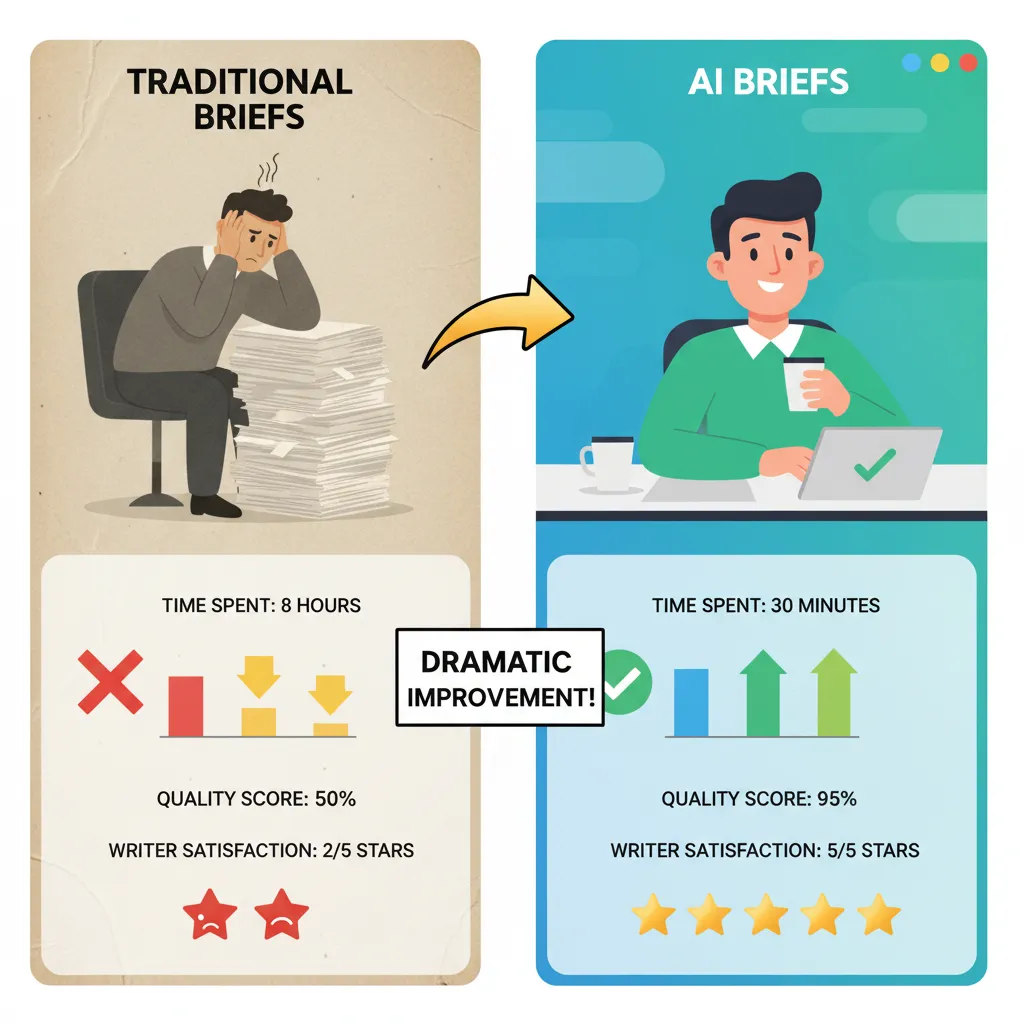
Both approaches create friction. One team that tracked this carefully reported that traditional briefs took 8 hours per article to produce, and even then, quality scores averaged 6.8/10. Writer satisfaction was 6.1/10. Articles needed an average of 2.3 revision rounds before they were ready to publish.
That’s the baseline. Now, what happens when you automate the research and structuring part?
What an AI Content Brief Actually Includes
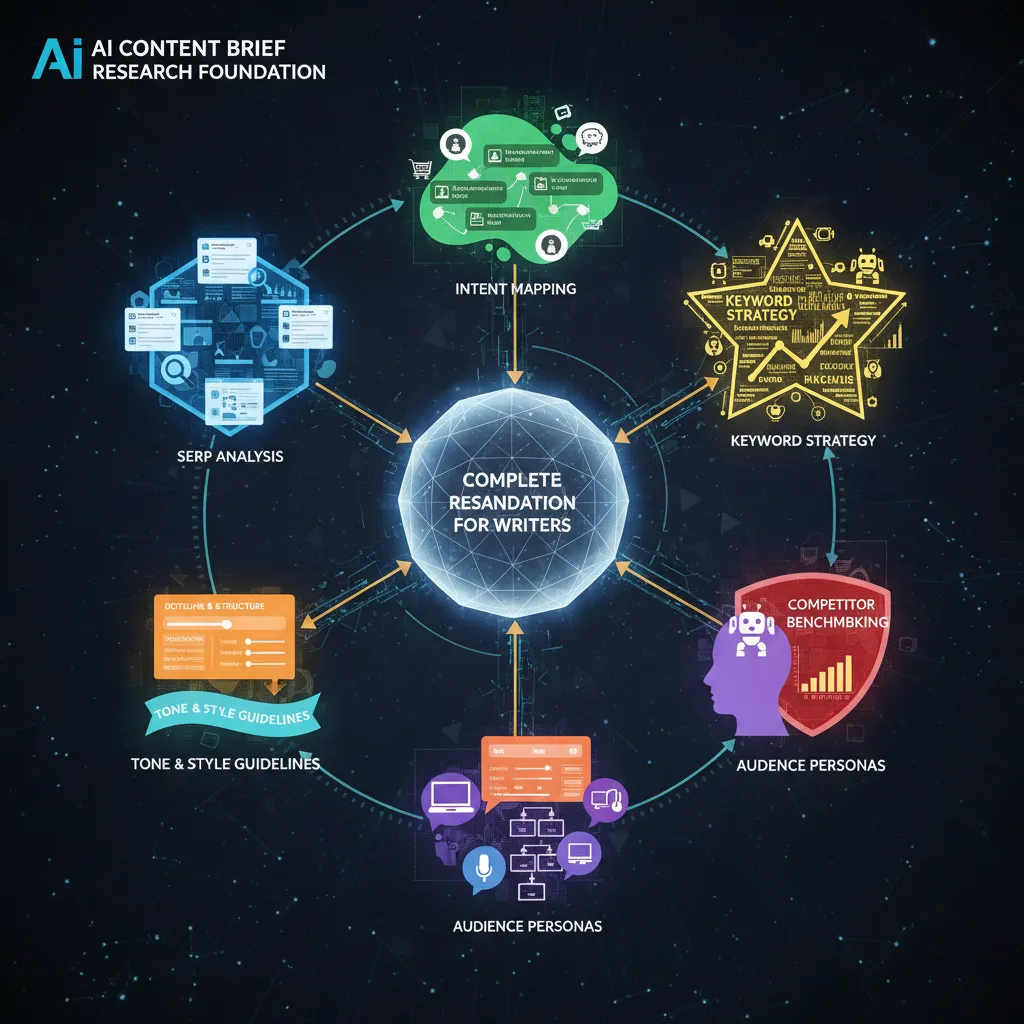
An effective AI content brief is not just a prompt that says “write about this topic.” It’s a structured output that handles the research phase entirely.
Here’s what a good AI content brief should contain:
SERP Analysis. The AI analyzes the top 10 ranking articles for your target keyword. It identifies what they cover, how they’re structured, and what gaps exist. This is the foundation of competitive differentiation.
Search Intent Mapping. The brief clarifies whether the search is informational, commercial, or transactional. It identifies related search intents and questions users are actually asking. This prevents you from optimizing for the wrong angle.
Keyword Strategy. The brief identifies primary and secondary keywords, long-tail variations, and semantic terms to naturally include. It prioritizes them by relevance and search volume.
Content Structure. The AI suggests a logical outline with recommended section order, but not as a rigid requirement—as a starting point. Sections include estimated word counts and the intent of each section (e.g., “build authority,” “answer user objection,” “provide step-by-step guidance”).
Competitive Gaps. The brief explicitly highlights what competitors miss. This is where your content gets an edge. Maybe no one’s covering a specific use case, or all competitors are missing a recent development in the field.
Quality Standards. The brief defines what E-E-A-T signals the piece needs. Should it include original data, expert quotes, case studies? What proof points matter most for this topic?
Data and Statistics. The AI identifies key statistics, studies, and data points that strengthen the piece. It even suggests where to find them.
A writer receiving this brief knows exactly what problem they’re solving and has the research foundation to solve it. They’re not starting from zero. But they’re also not locked into a formula—they have room to adapt, to find better examples, to follow interesting threads that emerge during writing.
The Numbers: What Actually Happens
Let’s look at three real cases from practitioners who’ve implemented AI content briefs at scale.
Case 1: Agency Switching to AI Briefs
A content agency switched their entire team from traditional briefs to AI-generated briefs using a structured prompt. The results were immediate and dramatic:
- Time per article: 8 hours → 4.5 hours (3.5 hours saved per piece)
- Quality score: 6.8/10 → 8.2/10
- Writer satisfaction: 6.1/10 → 9.2/10
- Revision rounds: 2.3 average → 1.1 average
The improvement in writer satisfaction is worth noting. When briefs provide structure without over-specification, writers enjoy the work more. They feel trusted. They also produce better content because they’re not fighting constraints.
Case 2: Hybrid AI at Scale (47 Articles Per Month)
Another team adopted a 40/60 model: AI handles research, outlining, first-draft structure, and SEO optimization. Humans add experience signals, fact-checking, original insights, and brand voice. Publishing 47 articles per month at 3.5 hours each:
- 89% of articles rank in the top 10
- Average time on page: 4.2 minutes
- Conversion rate: 2.7%
- Bounce rate: <25%
- Organic traffic growth: 340%
- Conversion growth: 23%
- Revenue from organic: $2.3M
This is the hybrid model working at full scale. AI briefs don’t replace human expertise—they amplify it. The humans focus on what they do best: adding depth, credibility, and original thinking. The AI handles the grunt work of research and structure.
Case 3: Solo Practitioner Using Claude Prompts
A solo operator built a detailed Claude prompt that generates comprehensive SEO briefs, essentially replacing a paid SEO tool subscription ($800/month). Over 6 weeks, they ranked a piece from position 47 to position 3 for “AI productivity tools” (90K monthly searches). Across 47 briefs created with the prompt:
- 83% of content ranked in the top 10 within 90 days
- 39 out of 47 pieces ranked top 10
- Briefs took about 3 minutes each to generate
This case proves that the AI content brief approach works at any scale—from solo operators to large agencies. The mechanism is the same. Better research and structure at the front end means better content and faster ranking.
Why AI Briefs Work Better Than Traditional Ones
There are three core reasons why AI-generated briefs outperform manual ones.
Speed. An AI brief that would take a human strategist 2–3 hours to research and write is generated in minutes. This means you can brief more articles faster. It also means you can iterate—if a brief doesn’t feel right, you regenerate it with a different angle in seconds.
Consistency. Human strategists have off days. They miss competitors, forget to check recent updates, or structure briefs differently depending on their mood. AI briefs follow the same structure every time. Every brief includes SERP analysis, intent mapping, gaps, and quality standards. Writers know what to expect.
Data-Driven Decisions. AI can analyze 10 or 20 competing articles in the time it takes a human to read two. It identifies patterns humans miss—what structure wins, what sections appear in top-ranking content, what points differentiate the outliers. This is pattern recognition at scale.
Reduced Revision Cycles. When a brief is thorough and well-structured, writers make fewer mistakes. They don’t go down research rabbit holes. They don’t misunderstand the intent. The result is fewer rounds of revisions, which saves time and improves morale.
But there’s a nuance here. An AI brief is only as good as the prompt you feed it. A vague prompt (“write a brief about productivity tools”) produces a vague brief. A detailed prompt that specifies what analysis you want, what structure you need, and what quality standards matter produces a usable brief. The investment is in getting the prompt right once, then reusing it.
The Hybrid Model: Where AI Briefs Deliver Maximum Value
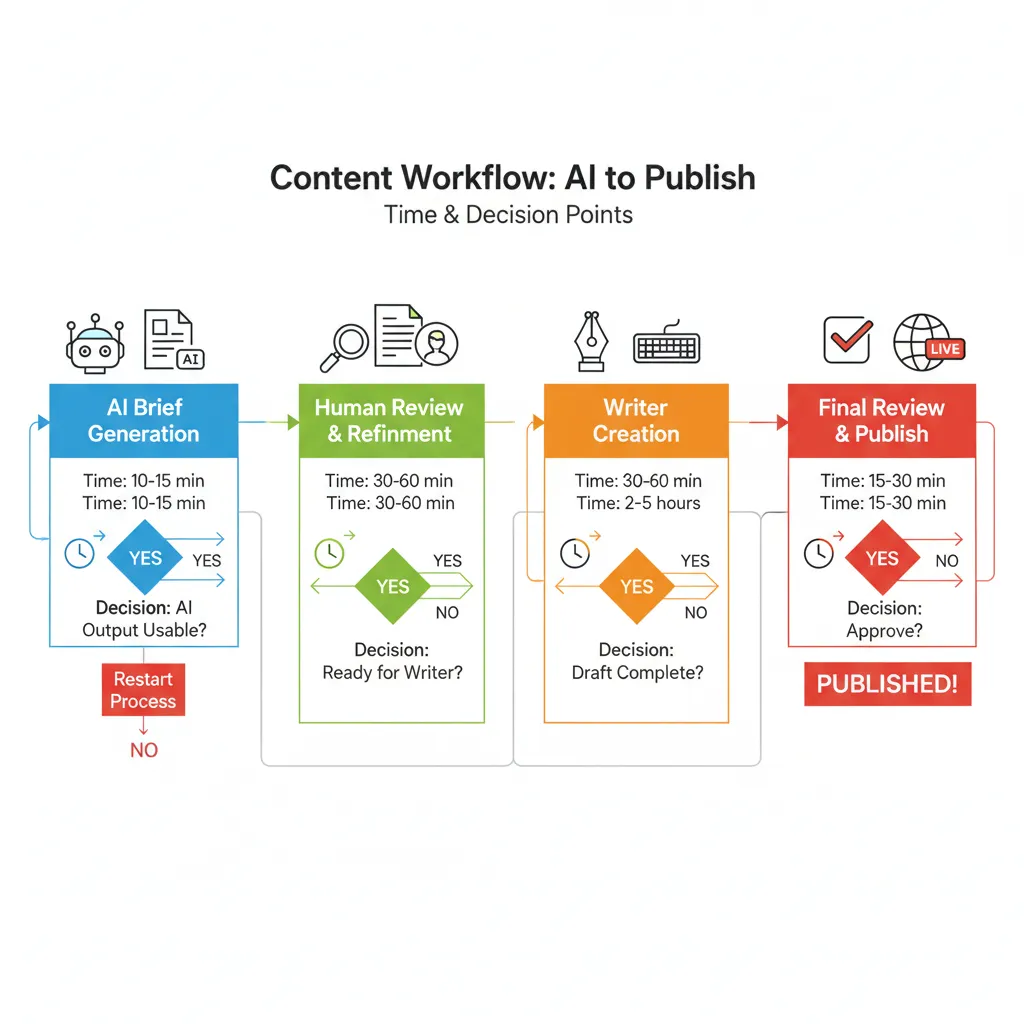
The most effective approach is not “AI writes the brief, humans write the article.” It’s “AI researches and structures the brief, humans write with expertise and original insight.”
In practice, this looks like:
Phase 1: AI Generates the Brief (5–15 minutes)
Feed your target keyword and angle into your AI brief prompt. The output includes SERP analysis, keyword strategy, outline, competitive gaps, and quality standards. You now have a research foundation that would have taken 2–3 hours to build manually.
Phase 2: Human Review and Customization (5–10 minutes)
A strategist or editor reviews the brief. Do the competitive gaps match what they’ve seen in the market? Is the outline structure right? Are there angles the AI missed? They make adjustments, add context, or approve as-is. This step ensures the brief matches your brand and strategy.
Phase 3: Writer Creates With Direction (2–4 hours)
The writer has a clear roadmap. They know what competitors cover and what gaps exist. They have keyword targets and section structure. But they’re not locked in—if they find a better angle, better data, or a more compelling structure during research, they adapt. The brief provides direction without killing creativity.
Phase 4: Review and Publish (30–60 minutes)
Because the brief was thorough and the writer had clear direction, the review is faster. Fact-checking and polish happen quickly. Fewer revision rounds.
The entire cycle—from keyword to published article—happens in 3.5–4.5 hours instead of 8. And the content ranks better because it’s built on solid research from the start.
Common Mistakes Teams Make With AI Briefs
Not every team that tries AI briefs gets good results. Here’s where most stumble.
Using a Generic Prompt
A generic “write a content brief” prompt produces a generic brief. Effective AI briefs require a detailed prompt that specifies exactly what analysis you want, what structure works for your niche, and what quality standards matter. Invest in building your prompt once. It pays dividends.
Treating the Brief as Gospel
Some teams generate an AI brief and lock it in as immutable law. The writer can’t deviate. This defeats the purpose. The brief should be a starting point, not a straitjacket. Writers should feel empowered to adapt when they find better information.
Skipping Human Review
An AI brief generated without human review sometimes includes inaccurate competitive analysis or misses important context. A 5-minute human review catches these issues before the writer starts. This saves time overall.
Not Updating Briefs Regularly
SERP results change. Competitors publish new content. A brief that was accurate three months ago might be outdated. Regenerate briefs periodically, especially for evergreen topics that get regular updates.
Underestimating Writer Skill
An AI brief is not a substitute for a good writer. It’s a foundation. A skilled writer working from a solid brief produces better content than a mediocre writer working from the same brief. The AI brief amplifies what the writer brings to the table.
Tools and Approaches: How to Get Started
You don’t need expensive software to create AI content briefs. You have several paths:
Custom Prompts in ChatGPT or Claude
Build a detailed prompt that specifies the analysis you want. Feed it your target keyword, and it generates a brief. This costs nothing beyond your AI subscription. The limitation is that you’re doing one brief at a time, and you need to manually input keywords. But for small teams or solo operators, this is perfectly effective.
Prompt Templates and Systems
Some practitioners have published detailed prompt templates specifically designed for SEO content briefs. These are free or low-cost and save you the work of building a prompt from scratch. You can use them as-is or customize them for your workflow.
Content Automation Platforms
Services like TeamGrain integrate AI brief generation with content planning, keyword research, and distribution. They handle the research, structure, and even help distribute your content across social channels automatically. If you’re managing multiple writers or publishing frequently, this kind of integrated approach reduces manual work across the entire content operation.
The choice depends on your scale and budget. Solo operators thrive with custom prompts. Agencies managing dozens of writers per month benefit from more integrated systems that handle briefing, tracking, and distribution in one place.
Real-World Implementation: What Success Looks Like
When a team implements AI content briefs correctly, the shift is noticeable within the first month.
Writers stop asking clarifying questions about what the article should cover. The brief answers those questions. Revision cycles shorten because the brief caught potential issues before writing started. Publication velocity increases because each article takes less time. And because the brief is research-backed, ranking improves.
The teams that see the biggest wins are those that combine AI briefs with a realistic understanding of what AI does well. AI excels at research, synthesis, and pattern recognition. It’s fast and consistent. But it doesn’t replace human judgment about what matters in your market, what your audience actually cares about, or how to tell a story that resonates.
The hybrid model—AI handling research and structure, humans adding expertise and insight—is where the real value lives. That’s what produces content that ranks, engages, and converts.
Scaling Content Production Without Sacrificing Quality
One of the biggest wins with AI content briefs is the ability to scale. You can publish more articles per month without proportionally increasing your team size or time investment.
The agency publishing 47 articles per month at 3.5 hours each is a good example. At traditional speeds (8 hours per article), that volume would require a much larger team or much longer timelines. With AI briefs, they achieve that volume while maintaining 89% top-10 ranking rates and strong engagement metrics.
This scaling works because you’re removing the bottleneck—the research and structuring phase that used to take 2–3 hours per article. You’re not removing quality; you’re removing waste.
That said, there’s a limit. You can’t scale infinitely. At some point, you need more writers. But AI briefs let you get much further with the team you have. You’re getting more output from the same input, which is the definition of efficiency.
Frequently Asked Questions
Do AI content briefs work for all content types?
They work best for content where SERP analysis and competitive differentiation matter—blog posts, guides, comparison articles, how-tos. They’re less useful for brand storytelling, opinion pieces, or thought leadership where the insight is the primary value. For those, AI briefs can still help with structure and keyword integration, but they’re less central to the process.
How much does it cost to use AI content briefs?
If you’re using ChatGPT or Claude, you’re paying for the subscription (typically $20/month for ChatGPT Plus or Claude Pro). If you’re using an integrated platform like TeamGrain, you’re paying for the platform subscription, which includes briefing, keyword research, and content distribution. The cost varies, but it’s almost always lower than hiring a full-time strategist to write briefs manually.
Will Google penalize content made from AI briefs?
No. Google cares about content quality and relevance, not how the brief was created. A well-researched, original, human-written article created from an AI brief is no different to Google than one created from a manual brief. What matters is the final output.
Can I use the same brief for multiple articles?
You can, but it’s usually not ideal. Each article should have its own angle and target keyword. However, you can use the same prompt to generate briefs for multiple keywords, which saves you the work of building the prompt in the first place.
How do I know if my AI brief is good?
A good brief passes these tests: Does it identify real competitive gaps? Does it include recent, relevant data? Is the outline structure logical? Does it give direction without over-specifying? If the answer to all of these is yes, your brief is solid. If not, refine your prompt and try again.
The Path Forward: Making AI Briefs Part of Your Workflow
The evidence is clear. Teams using AI content briefs produce more content in less time, with better quality and higher ranking rates. The approach works at every scale—from solo operators to large agencies.
The implementation path is straightforward: Start with a detailed prompt. Generate a brief for your next article. Have a strategist review it. Let your writer work from it. Measure the time and quality difference. If it works (and it almost always does), expand to your entire content calendar.
The key is treating the brief as a tool that amplifies human expertise, not a replacement for it. AI is excellent at research and structure. Humans are excellent at judgment, insight, and storytelling. Together, they produce content that ranks and resonates.
If you’re managing a content team or publishing regularly, this is worth testing. Even a 30–40% reduction in production time compounds quickly. Across 24 articles a year, that’s 60+ hours saved. Across 100+ articles, it’s 250+ hours. That’s real capacity.
For teams serious about scaling content production without adding headcount, an AI content brief system is no longer optional. It’s the baseline.
Bringing It All Together
An AI content brief solves a real problem: the hours spent researching, analyzing competitors, and structuring content before a writer even starts. By automating that phase, you get better briefs faster, writers produce higher-quality content with fewer revisions, and your content ranks better because it’s built on solid research.
The teams seeing the biggest wins are those using the hybrid model—AI for research and structure, humans for expertise and original insight. This approach scales publishing volume without sacrificing quality or requiring proportional team growth.
If you’re publishing content regularly and looking to improve speed, quality, or ranking performance, testing an AI content brief workflow is a logical next step. Start small, measure the results, and expand from there. Most teams that try it don’t go back.
For teams managing multiple writers or publishing at volume, integrating AI briefs into a broader content platform—one that handles keyword research, brief generation, and distribution across channels—removes even more friction. That’s where you get the compounding benefit: faster research, faster writing, faster publishing, faster ranking, and faster traffic growth, all from a single system.